



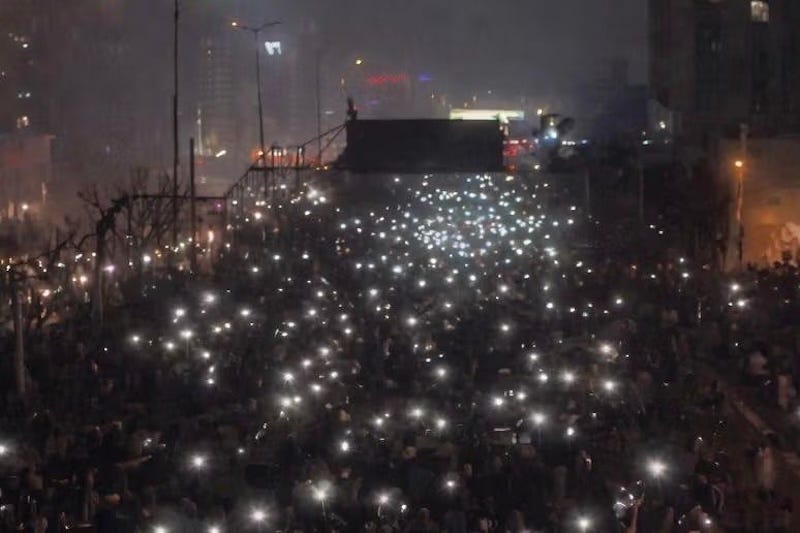
Red Threads Editorial Note: Three weeks ago, the US and Israel launched an aerial war of aggression against Iran, accompanied by a new round of Israeli violence in Lebanon and the Occupied Palestinian Territories, leading to thousands of deaths throughout the region. Following months of protests in Iran and their bloody repression, many expected the regime to suffer a swift defeat. However, despite the decapitation of its leadership, the regime has proved remarkably resilient and even taken the initiative, establishing a chokehold on one of global capitalism’s arteries, the Strait of Hormuz, through which 20 percent of global oil passes, and striking back powerfully at Israel and US allies in the Gulf.
On March 13, 2026, a week into the assault on Iran, Matan Kaminer of Red Threads conducted this interview with writer and journalist Shora Esmailian, based in Malmö, Sweden. Esmailian places the protests that sparked the recent state crackdown in continuity with waves of protest since the 1979 revolution. She points out that these waves have incorporated a wide range of demands around political freedom as well as economic, gender and environmental justice.
Esmailian highlights that resource extraction, and dependence on oil, gas, and steel production at the expense of working people, make the Islamic Republic a capitalist society, one in which the leadership enriches itself on the backs of the working class. Our conversation broaches - without being able to answer - that most difficult of questions: what should the left’s relationship be to regimes that may support liberation struggles externally while remaining oppressive internally , especially in a context where there is no alternative on the horizon?
Red Threads (RT) Thank you for agreeing to this conversation. Could you introduce yourself to our readers?
Shora Esmailian (SE) I was born in Tehran in 1981 and I came to Sweden as a nine-year-old refugee with my mother. My immediate family were all involved in the Revolution of 1979. I grew up in a leftist home, where I heard about everything from Palestine to Iran to US imperialism. My family never said much about what they did during the revolution, but they were secularists, leftists.
I started working as a journalist around 2004, when I went to Iran to report on the awakening labour movement together with Andreas Malm. We wrote a book, Iran on the Brink. Since then, I’ve covered Iran, Palestine, the Middle East, but also climate change and climate justice. I wrote a book on climate refugees in Pakistan, Egypt and Kenya back in 2010-11. My most recent book is in on Gaza and the genocide. I also work as a cultural journalist and writer.
RT Could you begin by telling us about the dynamic between internal resistance and repression in Iran on one hand and external aggression on the other in the lead-up to the current war?
SE During the protests in December and January, when a lot of protesters were massacred by the regime, Mossad was saying [its agents] are on the streets. Israel was saying, “do whatever you can to free yourself from the Islamic Republic.” And I saw a lot of leftists in Sweden just saying, “You know, these are not popular protests.” But protests have been bubbling up in Iranian society for twenty-five years. We had the students in the late ‘90s. They were crushed. We had the labour movement in the early 2000s. They were crushed. We had the feminist movement, who tried different ways, not only protest, but also reforming family law; they were crushed. We had the elections of 2009 and the reformist Green Movement. They were crushed. The leaders of the reformist movement that came out of the Islamic Republic itself were put under house arrest.
Then we had protests about water, corrupt banks, farmers who lost their land and moved into the cities and had some small savings in 2017, and the banks just disappeared and all their savings were gone, and now they didn’t have land because there’s been a thirty-year drought in Iran. And then 2019 again.
You can see all these protests for twenty-five years coming every second or third year or so. We have to see the protests in December-January as a part of all these protests. The promise of the Revolution of 1979 was that Iran would be a free Iran, free from oppression, both internally and externally, but also an equal society. That was what both the left and the Islamists said in ‘79.
These promises were never granted to people. They never saw the light of day. That’s why we see people go out now and then and protesting. And during all these protests, some of the demands have been political, like: Women want freedom. I want to dress as I want. I want to vote as I want. And then a lot of demands that are economic, like we want to actually be paid for our jobs. We want social insurance. We want pensions, we want better working conditions.
All these came together during the December-January protest when people went out because of high prices. But this time, very soon they started to say “Death to the Islamic Republic.” And it doesn’t matter that Mossad were on the streets of Iran, because we have been hearing these slogans for years, including during Woman Life Freedom [in 2022]. That was one of the biggest protest movements. Then you could hear “down with the regime,” but moreover, to question the veil is a revolutionary demand in the Islamic Republic, because that one the pillars that it stands on is forcing the veil on women. When some leftists are saying these protests were ignited by Mossad, I think it’s bullshit, because these are the Iranian people, going out saying what they’ve been saying for twenty-five years.
RT You mentioned the economic question. I’ve seen arguments recently that the sanctions regime has not only made life hard for ordinary Iranians, but has also enabled regime corruption. Do you agree with that analysis?
SE What we’ve been seeing for thirty or thirty-five years, since right after the death of Khomeini, is the Islamic Republic’s elite trying to enrich themselves. Once the Republic was established, it started executing leftists and Mojahedin at once. And then they had this war with Iraq that saved Khomeini for many years.
Nobody could protest anything during eight years of war.
I grew up during that war: it was daily bombings. Just before the war, on the 8th of March 1979, women went out to say no to the compulsory hijab. And then we had war for eight years and nobody could say anything. And when the war ended and Khomeini died, a new leadership took over and opened up the Islamic Republic, becoming a classic capitalist society where the leadership would enrich themselves on the backs of the working people. A decade later, when the labour movement started again, they said “look, we are seeing that people tied to the regime are running factories into the ground to be able to sell the lands.” That’s what the workers told Andreas [Malm] and me when we were in Iran. Or “they’re making us work and they’re not paying us for eight or ten months.”
So ordinary people in Iran, working-class or middle-class, had to work two or three jobs to live. And that, of course, has to do with the sanctions, because sanctions and the isolation of the Iranian regime, especially since the invasion of Iraq, have been crippling the economy. But at the same time, a small part of the elite, tied to the Islamic Republic, have been enriching themselves, living in luxury, building malls and talking “consumption is the way out of this crisis,” and so on.
The sanctions have been really bad on people and the government, but the Islamic Republic’s leadership could have done things very differently, at least paying workers. Instead of holding all the money, and then you see their kids living in luxury, you see their Instagram posts and what cars they have or what big weddings they have, and so on. That is not a leadership that takes care of its own [people].
RT It’s interesting what you say about the Iran-Iraq war. I hadn’t realized before that this use of external aggression to strengthen internal power is something that the regime is already very practiced at. Do you see a parallel to today?
SE I really do. During the Iran-Iraq war, nobody could go out and say no to the war, because Iraq had attacked Iran. So Khomeini could say “we are defending ourselves.” But how did they defend themselves? They sent millions and millions of young boys to the front, and they were killed in the most devastating ways, you know, just running and having a key around their neck signifying that they would go to heaven. But they were just running towards mines. It was a horrible war, and I remember the only way we had to protest. We used to get bags from school, with a note that would say something like: “2 pairs of men’s underwear, 2 pairs of socks, 3 cans of food.” So that the families would fill them and send them to the front.
And I was living alone with my mother and she was like, “no way, I don’t even have a man at home with men’s underwear. And even if I did, I wouldn’t.” So she let me go back to school with the bag empty. That was the only way to protest. During those years, thousands of leftists were executed in prisons, and people could not even protest against that, because the lid was on so hard.
The war was kind of a saviour for Khomeini. And that is, I think, what is going to happen today. When I saw the protests start again after forty days of mourning in February, I became hopeful. All these students going out. We had students praising the son of the Shah, but we had also students saying “Woman Life Freedom” or “behind every killed comrade, there are hundreds of comrades,” and so on. So I had a lot of hope, because it was four or five days of continuous protest at the universities, even though the Basij, the paramilitary force, would really beat them, try to arrest them. But they kept going out and it felt like what I had read about the revolution in 1979, that revolution is not something that happens from one day to another. It’s a process.
When the students keep going out after they’ve been massacred, and they’re being attacked by the Basij, it means something. It means that the will is still there. And I was thinking maybe I could go back to Iran this year. But what shut them up was not the Basij. It was not the Islamic Republic. Maybe if it had continued, it would be them, like it had been with all the other protest movements, because the Islamic Republic’s only language towards protests is repression, and hard repression. They don’t have any other sort of language.
But this time it was the war. That totally silenced the students and their demands for change. We don’t know how long this war will go on. We don’t know what country they will even have to protest for, but what I know is that after a war, it’s not easy going out and saying we want the end of the Islamic Republic. It is like these bombs really threw back everything in Iran, from infrastructure to social organizing and political organizing, at least ten or fifteen years back.
RT Can you describe the internal composition of the opposition in Iran before the war? I know it’s much more complex than what is portrayed on the outside, either by the liberal media or the campist left.
SE Iran is a very diverse society. It’s difficult to know how much of the population supports the Islamic Republic. Some figures say 15%, some 20%. But what we know is that these different attempts to organize, the students, the labour movement, the women’s movement, have all been crushed by severe repression. They literally silenced workers’ leaders by cutting out their tongues in 2006, when the bus drivers were trying to unionise, or all the imprisonment of [participants in] the women’s movement during 2007-8, or all the killings after the Green Movement 2009 in the prisons.
It’s difficult to say that there is an organized political opposition in this country, because it’s been impossible. And since the invasion of Iraq in 2003, the US and Israel have been threatening Iran with war. For twenty-something years, every time people went out, the regime represses them, takes their leaders and accuses them of running errands for the empire. It’s also very difficult to have something ongoing for years. Really, the labour movements tried in the beginning of the 2000s, but a lot of them were imprisoned and the labour movement died out. But we have intellectuals who came out during the war this summer, [from] the writers’ union, They came out with statements saying “no to war and no to the Islamic Republic.” And they were all imprisoned.
RT Another way of approaching this question is that we’ve seen different epicentres of the explosions over the last few years, right? Feminist movements, environmentalist movements – what are the different kinds of fault lines that the resistance has taken in recent years?
SE The Woman Life Freedom movement is very interesting because for the first time since the revolution in ‘79, the movement spread all over Iran in just a few days. It started in [Iranian] Kurdistan, but then you suddenly saw women in Baluchistan, that is a Sunni minority area and very religious, very traditional. Women, fully veiled, not the Tehrani style where veil starts in the middle of your head, walking in big demonstrations saying “Woman Life Freedom,” and for them, the compulsory hijab was not the most important thing. For them, the drought that has been going on in Baluchistan for the past thirty years and affecting their lives was the most important issue and they chanted about water.
The Baluchi minority have been so repressed, not only because of the drought. The regime hadn’t done anything for them. Their children go to schools that don’t have heating in the winter or cooling in the summer. They don’t have hospitals, water pipelines. So it was interesting to see that during Woman Life Freedom, all these questions about environmental disasters came together. And all this other baggage of being repressed in different ways came out in that movement. So that was also why that movement was very hopeful.
But then you have a capital, Tehran, lying below a mountain chain, and suddenly you don’t have enough water. Last October President Pezeshkian was saying ”if it doesn’t rain this autumn, we have to move the capital.” How do you even move a capital with 10-14 million people? A country like Iran is vulnerable to climate chaos, especially when it comes to droughts.
But it’s also important to remember that water management in Iran has to do with these “millionaire mullahs,” as we called them in the book. Look at Zayanderud, it’s the biggest river in Isfahan. Some years ago Zayanderud was totally dry for the first time in history. Of course, that has to do with the drought, because it’s not raining enough in Iran, but it’s also because around Isfahan there are a lot of steel factories, and those factories are owned by people with connections to the Revolutionary Guard, and there was total mismanagement. Steel production requires a lot of water, and they were not using it in a sustainable way, they were totally emptying all the aquifers under Isfahan, Kerman and other cities.
It says a lot about how this regime has not tried to fulfil any of the promises of ‘79, that they would take care of the poor who had suffered during the rule of the Shah; they just enriched themselves. They don’t care. They didn’t manage anything in a sustainable way. Climate change really meets the mismanagement of a corrupt leadership in a very bad way. And all these crises coming together are making life really, really hard.
RT Does this analysis also extend to the way oil has been managed? Levels of renewable energy use in Iran are among the lowest in the world. There doesn’t seem to have been any attempt to wean the economy off dependence on oil.
SE No. And that is very strange, because when you’ve been living under sanctions for thirty years, did you ever think about shifting your economy to something that works for you? You have a lot of sun, you have a lot of desert. You have a lot of wind. It’s a really big country with different sorts of nature, but they never tried to pursue that. Instead, they made rivers and lakes totally dry up.
The environmental movement hasn’t been so big in Iran, but you had some both old and new activists that tried to raise these questions and link them to climate change as well as mismanagement by the leadership. And you know, they just disappeared. People don’t even know where they are. When it came to the labour movement or the women’s movement or the student movement, people were imprisoned and maybe killed in prison, but people knew where they were. When it came to environmental activists, they just disappeared.
I think that has a lot to do with the threat they posed to the Islamic Republic, because [the regime] really wanted to silence them. They didn’t want these activists to put political thoughts in the minds of the people and have them make the analysis. But they have a lot of oil; now they have more gas. I don’t understand how this this regime thought that, after all these years of sanctions and isolation, maybe they were hopeful that they could start selling gas – but no, there is not much going on when it comes to wind or water or sun.
Water and droughts are important in Iran because it has a lot of aquifers, but it’s fossil water. When you use it, it runs out and when it’s finished, it needs a lot of years of rain to fill up again, and the rains are not coming. I think that’s the most important mismanagement that has been going on.
RT There’s also this ancient technology of irrigation with qanats, right?
SE Yes. That is how people, even in arid places like Kerman where my father’s family is from, have been able to farm. My grandfather and his brother bought a piece of land where they had pistachio trees. It’s very arid there, they don’t have much water, but with the help of the qanats, they’ve been managing for generations. But then, in the past twenty years, my father’s family lost half the land and the trees because of the drought. And my uncle was saying some years ago that when they try to pump up water from these aquifers, there is none any more. You know, the qanats were exported throughout the Middle East because they were a sufficient way of using the land in this very arid part of the world.
RT And this infrastructure has been allowed to disintegrate?
SE Yeah, because when it doesn’t rain into the qanats, you cannot pump up the water, you cannot use the qanat.
RT I’d like to return to the international questions. Before the war, I would have said that it looked like the militarized strategy of resistance [to the US and Israel] had failed over the last two years. Hizballah had been beaten back, the Assad regime in Syria fell, Hamas lost control over most of Gaza, the Iranian regime looked very weak. And they were all weakened by deep unpopularity at home. But I’ve been surprised by the way that Iran and Hizballah have managed to hold up and fight back.
We don’t live in the kind of world that we would like to live in, and there are all sorts of difficult choices that people living under oppression have to make. Given what we’ve seen over the last two weeks, what’s your appraisal of the way forward for progressive or liberatory movements in the Middle East? In terms of the question of armed struggle, and also of the relationship to regimes that might be supportive of liberation struggles in one area, but also oppressive in another?
SE It’s a very difficult question. I can start with this: I’m very sad that we don’t have a left anti-war movement in Europe like we did in 2003, and it is really making it difficult to go to the squares and to say “no to war, no to the Islamic Republic, and no to the Shah.” That is what I want to scream. I’ve been protesting for Iraq, Kurds, Palestinians for so many decades now, and I would like to take my kids to a demonstration for Iran against all oppression. But it’s really difficult to do that because if we do, either we would be accused of being on the side of the Islamic Republic by the royalists – and they are crazy aggressive, they are fascists, really fascists, at least here in Sweden – or we would kind of be played, the Zionists would say, “oh, so now you are against the Islamic Republic: here is an Israeli flag for you!”
It’s so confusing right now, and it’s so difficult to do something. I read testimonies coming out of Iran. It’s horrible. And they’re saying, “just do something, go out and be our voice and say no to the war and say no to the Islamic Republic.” It shouldn’t be that difficult, but it is. You have to go back in the modern history of Iran about 120 years, to the Constitutional Revolution, to see what this is and what is happening in Iran now. Every time we had a movement by the people that threatened the state, some empire, whether Russia or Britain or the US, came in, stopped it and put in their own puppets. That happened during the Constitutional Revolution in 1905-06 and during the 1953 coup against Mosaddegh. And the only conjuncture in in this history when people actually said no both to the dictatorship and to imperialist intervention was the Revolution of 1979.
The Islamic Republic has destroyed everything, but [back] then the left and the Islamists were saying the same thing. They were saying Iran should be free and independent. So when we think about today, interventions have never been good for the ordinary population in Iran, whether you’re a worker, a women’s rights activist or a minority.
I agree that if Israel and the US win this war, and if they are the ones taking down the Islamic Republic, then we have a Middle East where for the first time US and Israeli hegemony is total. So it’s a very frightening time. And I think Netanyahu is trying to do this because he doesn’t know what would come out of a popular revolution in Iran. Sure, for the past few years you have been hearing inside Iran, “don’t put the money in Gaza, don’t put the money in Lebanon, don’t put the money in Syria, put it in us.” That’s not so progressive, but people are saying this because they don’t have food on the table for their kids. Still, I don’t think that the memory of the Iranian people is so short. I think if you had a change in the regime that came from within Iranian society, it wouldn’t be a totally Israel-friendly or US-friendly regime. It would be more independent than that. I think that is also why Netanyahu is really pushing up the son of the Shah; we saw Haaretz’s investigation of the social media accounts helping the Shah and so on.
RT That reminds me of something that then-Israeli Foreign Minister Lieberman said in 2012 during the Arab Spring, that if the revolutions in the Arab world are allowed to win, if Egypt becomes a democratic country, then it’ll be more dangerous to Israel than the Iranian regime.
SE That is true, actually. It’s important to remember that this narrative that the Islamic Republic has about itself, that it’s supporting the Axis of Resistance, and of course October 7th would never have happened if we didn’t have Iran. But also, what the fuck did they do after October 7th? Iran could have done something to avoid a full genocide in Gaza. I really think they could have, but they didn’t. They even stopped Hizballah from doing more. I don’t see this regime as a protector of Palestinian people, or a protector of the oppressed in this region. They want their power and their hegemony, and they want to be able to enrich themselves. But on the other hand, what do we do when we have a fully Israeli-US-controlled Middle East? Then we have fascism from India to the Sahel region and nobody undertaking any resistance.
I still want to claim that progressive leftists in the West should say no to war and no to the Islamic Republic, and also no to a puppet, whether it’s a Shah or Maryam Rajavi or whoever that the empire wants to put in that place. And I think it’s important to hold this line and not to defend the Islamic Republic on the pretence that they support Palestinian liberation, because I don’t see them being close to doing that.
RT You mentioned the anti-Iraq war movement. Then I think it was pretty easy for most people to say they don’t support the Saddam Hussein regime in any way, but they also don’t support the war. It was somehow much easier then to make that distinction.
SE Yeah. But at that point the left was also much stronger in Europe. We had years and years, with the World Social Forum and the summit protests, and Ya Basta in Italy. Today we don’t have that, we live in fascist times. Sweden is one country that is really running towards fascism. It’s another world order. But you’re right. We didn’t support Saddam Hussein when we went out in our millions and said no to the war.
RT At Red Threads we’re very interested in thinking about connections between world regions that don’t run through Western Europe or North America. Is there anything about these regional connections that you think we should be looking at?
SE I don’t know much about Eastern Europe, but the other day I saw a Bosnian friend posting that people were putting flowers outside the Iranian embassy in Sarajevo. Of course that has a lot to do with what Iran did during the genocide in Bosnia, but that regime was a totally different regime than it is today. I don’t know what more to say, other than that it seems like Russia is going to be the big winner in all this because suddenly they can sell their oil and gas again.
RT But Russia’s also been supporting Iran militarily, right?
SE Yeah, of course, and Iran has been supporting Russia with drone technology in Ukraine. But I was just listening to the news this morning and Trump is saying, “you have thirty days where you can buy Russian oil.” Suddenly it’s okay. No sanctions for the next thirty days.
RT Ideologically, the Russian and Iranian regimes don’t seem to have much in common, but they have forged a strong alliance over the last decade or two. Is there anything that we should be paying attention to in that relationship?
SE You know, we don’t have an official Cold War, but we still have a country in the Middle East that is talking about anti-imperialism. And so they are the only ones that Russia could support.
RT And what about China’s role?
SE That is so strange. I don’t know much about China either, but I’m fascinated with their complicity and silence, when it came to the genocide in Palestine or now this war. A lot of the markets in Asia are affected because of the closure of Hormuz, and they’re silent. What are they doing under the table all the time? Because they keep being a strong power. They seem not to ever lose anything. I don’t know much about it, but I’m fascinated, especially now that they rely on a lot of Iranian oil, and how will that affect such a big country with so much production?
RT They have been making a lot of investment in renewables, so they’re less dependent on oil than they were.
SE Yeah, but China has also seen Iran as a backyard for selling products. The past twenty years, because of the isolation, you find almost only Chinese products in the bazaars. So I think Iran is very important for them, but I haven’t heard them say much about this war.
RT Given that the discourse of the regime is so strongly Islamist, how does it present its relationship with these two countries that are not Islamic or even Muslim? Is this completely pragmatic, or is anti-imperialism, a Third World kind of position, still involved in any way?
SE Yeah, I think it’s more about anti-imperialism than anything else. Because look at the Muslims in China and how they’re being treated. Has Iran ever said anything about that? No. They just keep buying stuff from China without ever protesting anything.
RT Yeah. And Russia has its own share of Islamophobia.
One last question on the politics of the Iranian diaspora. Right now the monarchist ideology is extremely strong there. As a member of the Iranian diaspora who’s obviously very opposed to this ideology, can you tell us about diaspora networks that are leftist or progressive?
SE This is such a sad question. What you have to know about the Iranian diaspora after ‘79 is that it’s very traumatized. The Iranian left had a lot to do with organizing a whole revolution, with the downfall of the Shah, with organizing unions and all these different movements, councils in workplaces, neighbourhoods and so on. When they lost the revolution to a despot like Khomeini, they were scattered all around the world and totally traumatized. So all these years, 47 years, they haven’t been able to organize because they’ve been just fighting each other. That is the left.
Then we have the royalists, a lot of people that fled at the end of the Shah’s rule with a lot of money. Many of them went to the US and ended up in Los Angeles.
And then we have the Mujahedin, a sect that fought with Saddam Hussein and turned their weapons against their own, and will never again ever be respected in Iran in any way. The US took away their classification as terrorists just a few years ago. Now their base is no longer in Iraq, but in Albania. But they’re very sect-like: people that go into Mujahedin have to give up their kids and go and fight for the cause and stuff like that.
So these are the three big exile groups and unfortunately none of these groups has come up with anything that is good or progressive, or something that could be used in a transformation after a popular revolution in Iran. So I don’t have any faith at all in the diaspora. We tried to show our solidarity with Woman Life Freedom, and during 2009, we had some demonstrations for the workers in 2004-6. But it’s not a power that you can rely on, I think, and especially the royalists, they are very toxic and they are really a product of MAGA and the right-wing and fascist movements in the US, and they have a lot of money and they pump it into TV channels and social media accounts.
And they’ve been really revisionist when it comes to the rule of the Shah . They have these documentaries where people who worked for SAVAK, who tortured Iranians in prison, are saying, “oh wow, it was so good under the Shah. Women could wear short skirts,” and pushing this nostalgia. So they’ve been really whitewashing the Shah and SAVAK. And they are very dangerous. So it’s a very sad story. I wouldn’t rely on any diaspora when it comes to change in Iran. I really hope that on the day that the people in Iran manage to do a revolution and to take down the Islamic Republic on their own, that the diaspora can hold itself and not get involved and destroy it.
RT It’s a very depressing situation, but I don’t think the US and Israel will win this war. And even if they do, they don’t really win. It’s a symptom of decline, of real collapse. And yeah, I don’t think China is going to be saving us, but I have this messianic side. I think sometimes things need to collapse for something new to emerge.
SE I hope so. What the students did just before the bombs started to fall was really, really hopeful. That the people keep going [out to protest] even though they know the level of repression. For thirty years, they’ve been seeing their comrades, their parents, their family members imprisoned, hanged, sitting in front of cameras on state television [after being tortured], saying, “I did wrong.” They still kept going out. And that means a lot when it comes to hoping for real change.
RT There’s a good chance that the moment the war ends, and it will end, then they’ll be back.
SE Yeah, but I think we’ll have to wait some years for that. The regime is sending threats to people right now saying “don’t come out, if you do then you’re on the side of the US and Israel.” And even socially, to be accused of being an Israeli spy, that is devastating for you, not only for going to prison, but also for your neighbours, for your workplace.
RT Yeah, and it really helps the regime that it’s not entirely made-up.
SE Yeah, no. All these Mossad and CIA posts in Farsi. It’s really, well, it’s fucked up.
RT I really agree with what you were saying before. We need to be careful about getting too conspiratorial about this stuff, but it does seem that, at the very least, Israel and the US know that they’re discrediting the opposition and they don’t give a damn about that. They don’t mind.
SE Yeah. And Trump is saying that this Pahlavi, he’s a nice guy, but he’s not cheering for him as much as Netanyahu is.
RT It’s the same as he did with the Venezuelan opposition, right? He doesn’t respect these people.
SE Yeah. Reza Pahlavi is really a clown. How have you been spending so many years of your life in exile with so much money? And you cannot even start, I don’t know, a simple human rights organization? And suddenly he wants to be the leader.
RT I don’t think that’s what bothers Trump about him. That’s very similar to Trump himself in a lot of ways, but no, Trump likes dictators. He likes strong men.
SE Maybe. But it’s really scary to read his document on Transformation Day in Iran. He is going to be the decision-maker in everything. Not the law, not the people’s court, nothing like that, he will make all the necessary decisions. Just like his father.