


This interview with LevFem was conducted by Burcu Ayan and published in Turkish in Çatlakzemin. Red Threads is grateful to them for letting us publish it in English.
Burcu Ayan: How did LevFem emerge, and what political and social context shaped its beginnings? In relation to this, how would you describe the broader landscape of feminist organising in Bulgaria today, and what strategies or tensions define the work of feminist organisations in the country?
LevFem emerged in 2018 in a very specific moment of upsurge and renewal in the history of the Bulgarian feminist movement. This was the year in which we experienced a massive, well-organized reactionary wave against the adoption of the Istanbul Convention (aka “Council of Europe Convention on Preventing and Combating Violence Against Women and Domestic Violence”, which reactionaries in Eastern Europe have accused of introducing “gender ideology”). Religious and conservative organisations, parties, and political actors were leading this campaign, and within only a couple of months, they managed to dramatically shift the public narrative around gender justice, women’s rights, and the rights of LGBTQI+ people. The campaign was deeply homophobic, transphobic, and misogynistic in its nature and specifically attacked the definition of gender as a social construct that is rooted in the Istanbul Convention. As a result, even the Constitutional court of the country declared that gender in Bulgaria is, apparently, a biological dichotomy, which makes it very hard to talk about gender, gender roles, gendered division of labor, gender specific policies, etc. As a direct aftermath of this reactionary wave, feminist and especially LGBTQI+ rights have been under a massive attack in the years since, and the lives of queer and trans people have been increasingly put in danger.
However, also as a result of this backlash, since 2018, there has been a surge in newly founded feminist organisations because we saw how organised and powerful the reactionary movements were, and still are. LevFem is part of this “new feminist wave” in Bulgaria in the aftermath of the lost battle for the adoption of the convention. LevFem was initiated as an informal group that included a handful of women and queer people from a few New Left groups that formed around the social centres, left-leaning publications, and movements in the 2010s. Its first action was a small online campaign that we issued around November 25th, 2018 - the International Day Against Violence against Women. We called on comrades to write short articles on violence against women. Our goal was to broaden the public discussion around the topic and thematise structural violence as gender-based violence: a topic and aspect that was ostensibly lacking from the public discussion. In the modern history of the Bulgarian feminist movement after 1989, violence against women has been very narrowly defined as domestic violence in a romantic relationship, and most of the efforts of the big women’s organisations in the past have been focused on lobbying and providing social services for survivors of domestic abuse. However, we know violence against women is much more than that. The exploitation in the capitalist system is a form of violence against women; racial capitalism adds the layer of racist policies and racist border regimes, which are also forms of violence against women; poverty is a form of violence; and so on. The issue is much bigger, and we knew that if we wanted to address it, we needed to address the systems that enable all aspects of gender-based violence - patriarchy, capitalism, and racism. This is the context in which we emerged and the message we have been trying to convey ever since.
Burcu Ayan: You bring feminist, socialist, and anti-racist perspectives together in your work. In a country with a socialist past and a complex post-socialist transformation, why is it important for you to hold these struggles jointly? What specific tensions or challenges arise from working across these perspectives in such a context?
We see our organisation as part of a lineage of especially autonomist Marxist feminism where patriarchy, capitalism, and racism are seen as systems of oppression that have been intersecting historically, socially, and politically to shape the specific forms of subordination that women and other marginalized groups experience. We see this tradition as important within the post-socialist New Left, because it allows us to both keep a deeply structural analysis, acknowledge structural advancements in the socialist past, as well as recognise some of the structural limitations of ‘really existing socialism’ in which actual policies and practices fell short of necessary deep structural change to combat capitalism, patriarchy, and racism. For us, then, naturally, as part of this political tradition, not acknowledging the complex ways in which these systems interact means that we would never be able to understand the roots of the problems and effectively fight them. For instance, it is impossible to fight for the liberation of women from patriarchal expectations and stereotypes if we don’t acknowledge how capitalism requires free labor of women (e.g., child care, cooking, cleaning, etc.) to guarantee the social reproduction of the workforce, which puts a double shift on the shoulders of the women workers. Similarly, it is futile to just fight for women’s rights without understanding how institutional racism guarantees that there is a supply of racialised workers who have worse chances to get a decent job and are thus easier to exploit - especially if they are women.
Basing our political activism on such a theoretical standpoint poses some challenges to navigating the present-day Bulgarian feminist field. The dominant political alignment among feminist organisations in Bulgaria in the last 30 years has been liberal feminism. We acknowledge and respect what these organisations have achieved, especially when it comes to legislative reforms against gender-based violence. Yet, we also see how this worldview limits the potential for a more daring feminist agenda that goes beyond fighting domestic violence and being on friendly terms with those in power to lobby for minor legal changes. Moreover, we are an openly socialist feminist organisation - this brings many negative associations because of the widespread cliche that socialism necessarily and always means repression and lack of democratic initiative. Anti-communist sentiments are very prevalent among the Bulgarian liberal middle class; this also affects some of the feminist organisations (especially the ones active before the 2018 wave of feminist mobilising around the Istanbul convention). In their reading, socialism achieved certain positive changes for women, but they were introduced from the top down, thus the “real” feminist movement (e.g. one that is similar to Western European feminism) started in the 90s. We dare to disagree. Socialism in Bulgaria (and elsewhere) is anything but a monolithic block of 45 years - there were more liberatory and progressive periods, as well as more conservative ones. The decision-making process within the Bulgarian Communist Party was much more complex and nuanced, and women were actively fighting within the ranks of the party for one or another feminist achievement. To completely erase these struggles is disrespectful to the work and achievements of generations of women.
However, our socialist identity does not mean that we have it easy with the contemporary left-wing political actors either. Bulgaria’s only prominent nominally left-wing party - the Bulgarian Socialist Party (BSP) - has taken a very conservative course since 2016 and was among the parties who were most vocally against the Istanbul convention. The ideological development of the BSP mirrors to an extent the development of SMER in Slovakia, even if the electoral results of the BSP in Bulgaria are tragic (currently polling between 5-7%), while SMER is governing Slovakia. It is easier for us to communicate with some members and factions within the BSP on the anti-capitalist axis and about women’s rights, however, the moment we mention LGBTQI+ justice, things get very ugly. The non-party left is small, fragmented and not very powerful: at the moment, LevFem is among the bigger, better-recognised, and organised collectives in this context.
Finally, as you can imagine, we are a target for different sorts of reactionary and conservative actors as we represent everything they hate - class-conscious feminists and anti-racists, who fight for queer liberation.
So we need to be smart and resourceful when navigating the field and searching for allies, but it is not mission impossible and we have had our successes - among some more progressive (feminist) organisations, politicians, unions, workers and younger activists.
Burcu Ayan: How do you understand the feminist labour struggle in Bulgaria today? What challenges do women workers face? As a feminist organisation, what has your engagement with trade unions and labour organisations been like? How have feminist perspectives been received in those spaces?
The feminist movement and the labour movement are fighting their battles separately, which is a dangerous development with long-lasting consequences in our reading. This is a direct result of the liberal understanding of the world that separates “human rights” (where feminism is usually positioned) from labour rights and tries to convince us that equality is achievable without challenging capitalist exploitation. For example, around March 2019, there were the March 8th feminist protests, nurses went on a national protest to fight for better labour conditions, and mothers of children with disabilities were taking to the streets the demands for better public care for their children. All these struggles were fought separately; there wasn’t a big joint demonstration. Now, some feminist organisations approached the nurses and the mothers of children with disabilities, but the latter decided not to join forces, as key actors in the nurses’ mobilisation were also affected by the ongoing conservative anti-gender wave that emerged around the adoption of the Istanbul Convention and saw the feminists as a threat. Here we clearly push for a feminist-and-labour movement that is able to see that beyond the liberal notion of separation between struggles. However, we also feel like the powerful reactionary agenda contributes ever more towards dividing the working class and weakening our power.
The lack of feminist reading within the contemporary organised labour movement in Bulgaria makes it harder for workers to understand the specific ways in which gender affects their experience at the workplace. For instance, very often we hear from women workers statements like “we have achieved equality, we have all the rights that men have, why should we bother about feminism”. Behind such statements, however, there is the same old story of invisible, underrecognised and poorly remunerated women’s labour: women predominantly work in fields that are badly paid; their salaries stagnate after maternity leave; discrimination is rampant towards women with small children during the jobhunt period (“she is a woman with small children, they get sick, she will be constantly taking leave to care for them, I can’t deal with this”); women shoulder the burden of the domestic, child care and elderly care labour at home and in their extended families and neighbourhoods; women’s pensions are lower than those of men because of the persistent gender pay gap and as pensions are calculated on the basis of lower salaries they got throughout their active years; and of course, sexual harassment at the workplace is a gendered experience that usually affects women.
In this context, Levfem is trying to act as the political agent that actively introduces labour issues and class consciousness within the feminist movement and pushes the feminist viewpoint within the labour movement. While our union organisations are usually acting as enclosed environments that solely focus on their specific agenda, we have managed to establish connections and have sporadic joint events and initiatives with some more progressive unions or feminised unions, which represent social and public workers, nurses and medical staff, and agricultural workers. We often invite their representatives as speakers to our events, and participate in their protests, and they have shared some of our content and have connected us to workers for interviews. Yet, while we see some increased sensitivity towards feminist viewpoints among some of the union members and workers, for the time being, the effects are predominantly on an individual level. We recognise, of course, that this is a long process and requires a lot of trust-building and work alongside the unions and movements. Our dream is that one day we will have a big feminist workers’ movement in Bulgaria that challenges the patriarchal capitalist system. But it is a rocky road ahead of us if we are serious about achieving this goal.
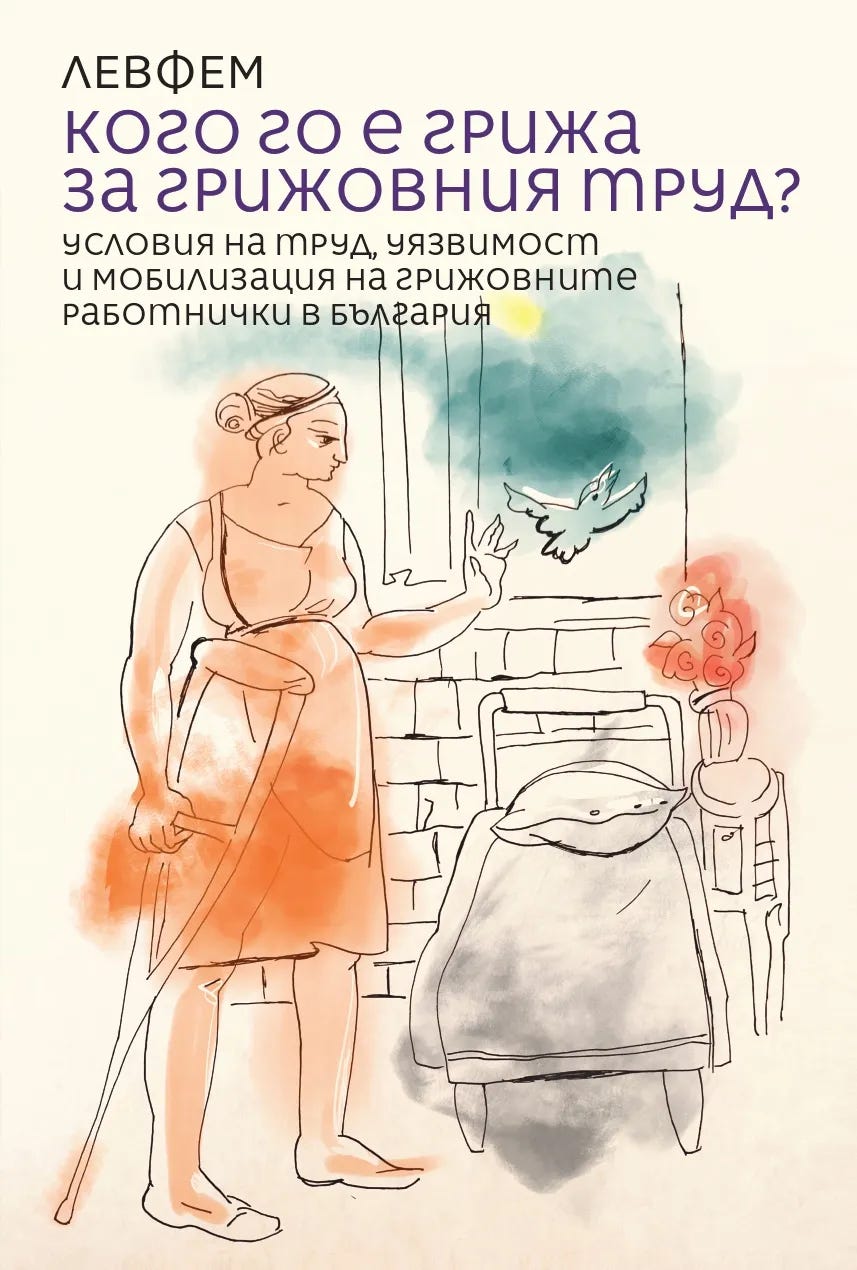
Burcu Ayan: Your report “Who Cares? Feminised Care Labour and the Crisis of Social Reproduction in Post-Socialist Bulgaria” offers a strong analysis of paid care labour in the country. Based on this work, where do you see the key sites of struggle around care today? And what practical steps do you think are needed to move toward public, accessible, and dignified care?
Given what we spoke about earlier, our report on the care sector in Bulgaria, based on 40 interviews with care sector workers, was published in a vacuum of political and public discourse and awareness about what we see as absolute core topics in the feminist and labour movement: care work and social reproduction, and their deficit and dire conditions in Bulgaria. First of all, we define the paid care sector rather broadly by including the systems of social reproduction - pre-clinical healthcare, early years, primary education, and social services. Very often, care work is defined even among feminists as the act of taking care of someone physically, but in our understanding care needs to be seen through the lens of social reproduction - the systems that make life possible. Having this theoretical understanding is useful to see the connections between seemingly very different sectors, but it also makes it very hard to highlight specific recommendations, as the situation in the healthcare system is different than the one in the education system, and elderly care takes many formal and informal forms.
Still, there are certain common traits that can be observed in all spheres of the care sector in Bulgaria. For instance, all of these spheres have a very feminised workforce and moreover - it is usually older women (50+) who predominantly find occupation in the care domain. Young people rarely choose these professions as the salaries are usually very low. In addition, many care workers choose to migrate to Western and Southern Europe in search of better pay, where they usually continue to perform care labour and are once again subject to harsh working conditions and racialised discrimination. These two processes result in a massive workforce shortage in Bulgaria, putting additional stress on the workers who remain in the system and creating a severe care deficit. As a consequence, people in Bulgaria have less and less access to decent care, as women working in the sector have all but decent working conditions. The lack of access to decent public care puts additional pressure on individual families (and specifically on women) to perform further unpaid care labour at home, while private providers are also invited to “fill in the gaps”, thus making access to decent care dependent on the financial situation of those in need. These aren’t problems specific to Bulgaria; many other Eastern European and Balkan countries face similar issues, while the deficit of care workers is a global phenomena. Yet, Bulgaria is specific as it shares some of the vices of both core and peripheral countries in the global economy. As a peripheral country, it sends care workers abroad. Yet, while it has the ageing population of a core country, currently it also has a particularly restrictive migrant labour regime which does not allow it to fill in the gap of emigrant care workers with immigrants.
Beyond this, we see two other major challenges ahead of us. First of all, there is no collective understanding of the care sector, except as ‘humane professions’ in which women’s ‘altruistic’ self-denial or even self-sacrifice is taken for granted. Equally absent is a shared public recognition of care as a human right and as a public good/interest. Furthermore, within a very re-traditionalising discourse that has soared since the conservative mobilisation around the Istanbul Convention, women are seen as possessing ‘natural qualities’ that make them more suited to providing care. These notions are not just prejudices, but have an impact on the material conditions of care work in both the workplace and the home. The result is, firstly, the feminisation of care professions and a shortage of male workers; secondly, low pay and low status, as well as poor working conditions in these sectors; and last but not least, the unequal distribution of care work at home, which is mainly performed by women.
There isn’t a silver bullet solution to address all these complex issues, but we need to start somewhere. In our analysis, we identify a number of steps that need to be taken in the short-term, middle-term and long-term for progress on this complex situation to be achieved. First of all, there is a need for a widespread information campaign that raises awareness of the challenges faced by care workers. It should address the links between ‘naturalised’ female care work, the poor conditions of pay and work in the care sector, and the nation-wide care deficit, and articulate concrete demands for financial remuneration and public recognition of work in this field. To this effect, one of our units is now engaged in the presentation of the report across the country and tailoring such demands together with members of feminist groups and labour unions in the care sector. Secondly, it is imperative to increase the pay of care workers as a whole, but also to reduce the differences between the private and public sectors and the differences in job hierarchies in certain sectors, particularly healthcare. We see it as unacceptable that the powers-that-be vote budgets that heavily subsidise military production and securitisation, not least as this is a direct pathway to austerity in all other sectors, including the care sector. And specifically for Bulgaria, there is a need for taxation reform, as we have suffered under a flat tax policy for the good part of two decades. We need a progressive taxation that puts the tax burden on the shoulders of businesses and economic elites instead of the working poor, as it is now. So a feminist initiative that wants to promote care as the basis that makes society possible should also engage with political demands for an economy that at least puts militarised capitalism in check (and at a later stage dismantles it entirely, of course). Third, there is also a need for effective policies, agreed upon by those working in the sector and their representative associations, aimed at tackling discrimination based on gender, age, ethnicity, etc. Finally, in our analysis, on an international level, there is a need for a solidarity care tax paid by wealthier countries attracting care workers to poorer countries like Bulgaria which send care workers in migration and experience a massive care deficit. We need to close the care work gap. We would like to oversee such a campaign first developing within the European Union, where Bulgarian trade unions, NGOs, and politicians have the opportunity to make this issue central to their mobilisation and lobbying efforts. Yet, if successful on the EU level, such a campaign should also be scaled up on a global level, within a larger struggle for reparation within colonial capitalism: we dream big.
Burcu Ayan: When you think about feminist organising in the Balkans, what shared challenges and possibilities come to mind? And how do you imagine solidarity and collaboration between movements in neighbouring countries such as Bulgaria, Turkey, and Greece, which often face similar political and social backlashes?
The Balkans is a very specific place with 12 countries (depending on how you count), at least 4 different language groups, and diverse ethnic and religious communities spread across a very small territory. We don’t even share a common language the way, say, Latin Americans do, and coordinating and organising among ourselves needs to happen in English. At the same time, we have countries with vastly different political pasts: imperial projects, anti-imperial struggles, former Eastern Bloc countries with diverse experiences with socialism, former Western Bloc countries, military dictatorships and coup d’état, genocides, wars and ethnic cleansing among neighbors, and more recently divisions across the lines of NATO and EU membership. Every 200 km, you have buried skeletons from past violent conflicts, which makes political organising incredibly challenging and nationalist sentiments very prevalent. All that being said, we can clearly see that we face some very similar threats - conservative waves that practically copy the same anti-gender narratives from Croatia through Bulgaria to Türkiye; increasingly more right-wing and even authoritarian governments; increased state violence on the borders to counter migration; deeply rooted corruption and oligarchic capitalist structures capturing the states.
The Balkans is also a place that has produced some powerful mobilisation waves in the last years - the Serbian students and their movement; the Romanian and Bulgarian anti-corruption protests; the Greek farmers strikes; the Turkish anti-Erdogan protests as well as the workers and feminist mobilisations around the withdraw of the country from the Istanbul convention; the Slovenian (and pan-European) My body, my choice campaign that took Europe by storm. There have been initiatives in the past that try to connect the struggles we face, most notably the migrant solidarity campaign across the Balkan route that has been active for about a decade, and more recently - the feminist network Essential Autonomous Struggles Transnational (EAST). EAST is a project that LevFem was heavily involved in as one of the coordinating collectives. It was an attempt to connect feminist, labour, and migrant organisations from Eastern Europe and beyond in the immediate aftermath of the COVID-19 pandemic, so that we have a space for exchange on the struggles in the social reproduction sector that we face. It was a common infrastructure via which we were able to better understand what was going on in different countries in the region, to show solidarity with each other, and learn from the strategic experiences of others. Unfortunately, the network is no longer active, but this type of common coordination and exchange space is clearly needed in our region. So we should probably start there.
Finally, in the last 30 years, at least in many post-communist countries, we have been convinced that we need to “catch up” with the West and be more (Western) European to have a decent life. However, the current protests in Bulgaria show a shift in this notion. While calls for Bulgaria to become a “decent European country” are popular among many of the protestors, there is something beyond this. For instance, we see how the protests are being described as “Gen Z” protests. While this description is in itself highly problematic and not at all representative of what is going on in the streets (where Gen Z is definitely not the most populous group among the protestors), it is an attempt to create and mobilise a collective identity that goes beyond the national and the European and ties Bulgaria to a global wave of protests among young people mostly in the Global South. We think that this shift in the collective imagination might be productive for the region more broadly. Maybe we can start thinking of identities that go beyond the national and the (white) European and tie us not so much to the hegemons and the powerful, but rather to the struggles of other ‘wretched of the Earth’ - the same way the Soviet Union was supporting the anti-imperialist and anticolonial struggles worldwide. Maybe a more productive way forward could entail building a collective Balkan identity that is rooted in our experience with historical complexities and traumas, but goes beyond the past and searches for connections with other pariahs of the world whose pain we can relate to and fight together.
Burcu Ayan: Looking ahead, what are LevFem’s main priorities? What kinds of political and organisational efforts do you hope to focus on in the coming period?
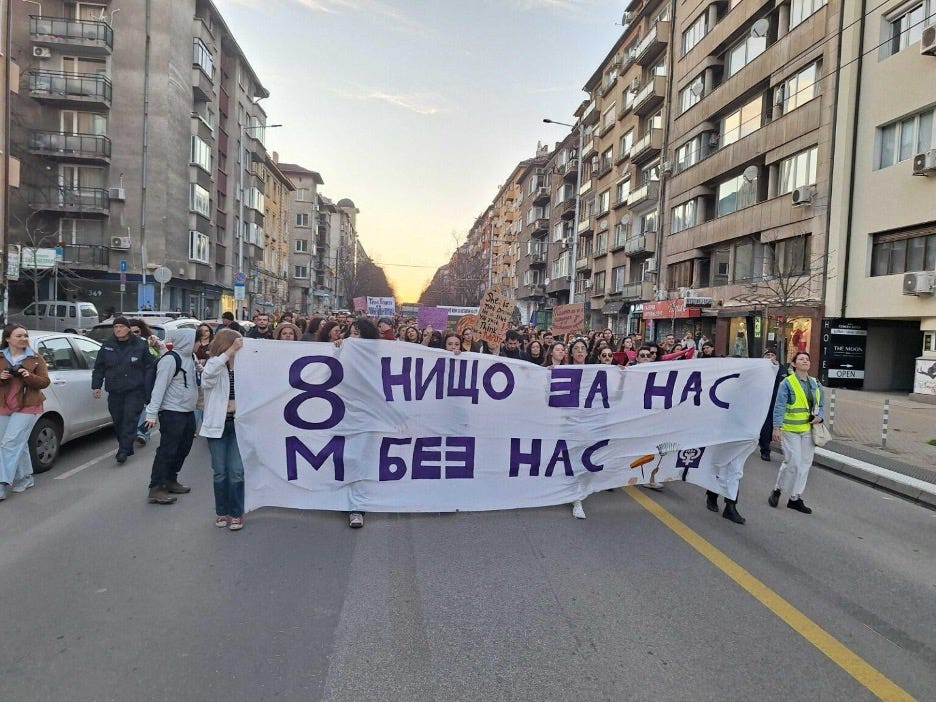
We would want to continue expanding our work on the care economy and possibly do a campaign with demands for better conditions in the care sectors around March 8th, hopefully in coordination with a bigger coalition of organisations. March 8th is usually a small demonstration in Sofia done by urban activists - this is a good starting point, but it needs to be much, much bigger, with women from all walks of life (care workers, office workers, self-employed, poor women, etc.) joining and demanding the dismantling of oppressive patriarchal, capitalist, and racist systems. We don’t have experience with bigger, more recognisable campaigns, so this will be challenging and exciting at the same time. Also, we would like to expand our capacities to fight against the anti-feminist and anti-gender movement: this has always been a priority of ours, but we have rather been reactive - the conservatives attack us, and we respond. We need to think about proactive strategies, too - and part of a proactive strategy needs to include political education that allows us to enlarge our base and convince more previously not politically active people to join the movement.