


Mark Carney’s speech at Davos in January 2026 has sparked a frenzy of truth-telling, which gives one the opportunity to assess the current state of politics and to reflect on the unified meaning of the transition to capitalism for the West and for the former socialist bloc of Eastern Europe, using the particular case of Romania.
Carney has brought the hard truth from his vast experience at the commanding heights of world economy, not only as Canada’s current prime-minister, but as the former governor of the Bank of Canada (2008-2013), who has faced the crash of capitalism in 2008 in such manner that he was appointed the first ever non-British governor of the Bank of England (2013-2020), having to deal in his mandate with the consequences of Brexit and with the quick succession of the failing governments of David Cameron, Theresa May, and Boris Johnson. Yet the speech itself, as remarkable as it is, is not the real turning point: the hard truth has come to the surface from within a historical process of denudation of the modern world. What seems to be chaos, the objective turbulence of the world-system at bifurcation, is only the result of hard truths being revealed the hard way, after the damage has been done.
The fracture within the Western world has widened so much that it has allowed Carney to say at Davos the quiet part out loud:
For decades, countries like Canada prospered under what we called the rules-based international order. We joined its institutions, we praised its principles, we benefited from its predictability. …We knew the story of the international rules-based order was partially false, that the strongest would exempt themselves when convenient, that trade rules were enforced asymmetrically, and we knew that international law applied with varied rigour, depending on the identity of the accused or the victim. This fiction was useful, and American hegemony in particular helped provide public goods, open sea lanes, a stable financial system, collective security and support for frameworks for resolving disputes. So we placed the sign in the window. We participated in the rituals, and we largely avoided calling out the gaps between rhetoric and reality. This bargain no longer works. Let me be direct. We are in the midst of a rupture, not a transition.
The Canadian banker thus explained that the elites of the Western world have simulated democracy for the rest of the world because they were complicit with the imperial hegemon and they were making money in the process. Deep down, it was all a lie. Carney also willingly admits in his speech that the Western powers have firstly lied to themselves that even though the game is rigged, it is good for the capitalist elites, and perhaps it was good enough for the lower masses and for the rest of the non-Western world.
Well, it was not. The turbulence shaking the world is precisely the result of the inflated lie bursting out. Carney’s speech may have been motivated by the desire to show that the emperor is naked, but that was not possible because these days the emperor goes out fully armored and weaponized. In his frustrated desire of denudation, Carney turned against the game he himself has been playing and pronounced the naked truth.
Carney’s speech made official the cracking into pieces of the dominant ideology of Eurocentrism and has a particularly important meaning for East Europeans because it spells out the unified sense of the post-socialist transition to capitalism for Eastern Europe and for the Western world. Carney emphasized his point by making a reference to Vaclav Havel’s essay “The Power of the Powerless” (1978), thus making a comparison between the state of late “communism” in the 1970s-80s and the state of global capitalism in the late 2020s. The comparison revealed more than it intended. For one, it recognized just how important the turn of 1989 for the capitalist elites of the world-system has been. Namely, from the Western standpoint, the dismantling of the East European socialist bloc has been a turning point and a victory for the rich and powerful. And indeed, whatever it was that happened in 1989 was turned from the 1990s into a frenzy of capitalist accumulation: the greedy win of the ruling classes of the world-system. Instead of an “end of history”, it was a new start of ruthless accumulation after the recession and stagflation of the Western world in the 1970s-1980s. As it turns out, the transition of Eastern Europe, therefore, was not as much about democracy as about obedience to and alignment with the moneyed and the powerful in the global class struggle. All the rest was secondary smoke and mirrors, with some crumbs left falling from the big table. One can surmise that, in the underbellies of the world powers, there was an underlying consensus between the liberal and the conservative tendencies within the Western representative democracy. Liberal democracy was the carrot to the conservatives’ stick, the shine given to the gearbox, in order to maintain superficial but acceptable appearances, and to decide who gets the acceptable crumbs feeding the same digestive organism. The historical period of the 1990s to 2020s reveals itself to be indeed the times of fake it ‘til you make it.
As it turns out, that meant creating the reign of the few over the many, beautified with the human face of liberal democracy. In the euphemistic terms of the liberal language, the period of transition has been for the countries of Eastern Europe the passage from the lowest inequality group to significant income inequality. “Weakening the scope of collective action” is another euphemistic term used for the adopted anti-social philosophy of the post-socialist governance, quite understandably for an economy based on the “privatization of gains but socialization of losses”. Such an unchallenged rule of the rich over the world is not sustainable, which would explain why it has to be weaponized. Even with a financial sector deregulated and set free from the embeddedness in the industrial sector, capitalism cannot keep on inventing itself and falls into bigger crises, compensated by ever bigger interventions from above, which in turn are reducing the state to a militarized coercive instrument. At the global level, the unchallenged rule of the rich and powerful has unleashed three decades of wars of colonial invasions, which have enticed the global empire to fall into hyperimperialism. It has devastated entire countries like Iraq, Afghanistan, Libya, and Syria, creating millions of refugees, and has polarized domestic societies. It has taken liberalism to absurd extremes, bringing the regression of proto-fascism at the center of politics and the return of fascist violence used by the repressive apparatus of the democratic capitalist states. The post-socialist rule of the imperial, rich, and powerful has only aggravated the dangerous rivalry with the pretenders seeking the status of the imperial, rich, and powerful. The superficial shine of liberal democracy has only served to establish the unprecedented rule of the richest 1%, who are possessing more wealth than 95% of the population of the entire world. Even the personal computer and the internet, hailed in the 1990s as irrepressible drivers of democratization, have been taken over by monopolies and turned into means of capitalized surveillance. On top of it all, the unchallenged rule of consumerist and extractivist capitalism has revealed itself to be a war on life that produces uncontrollable waste and has brought the world to the brink of ecological disaster. Now would be a good time to remember that the shiniest Western promises of the 1990s were that capitalism equals efficiency and that capitalism equals democracy; in reality, the world is overwhelmed by waste and war. Thus far, these hard truths have only been learned the hard way, after the damage has already been done.
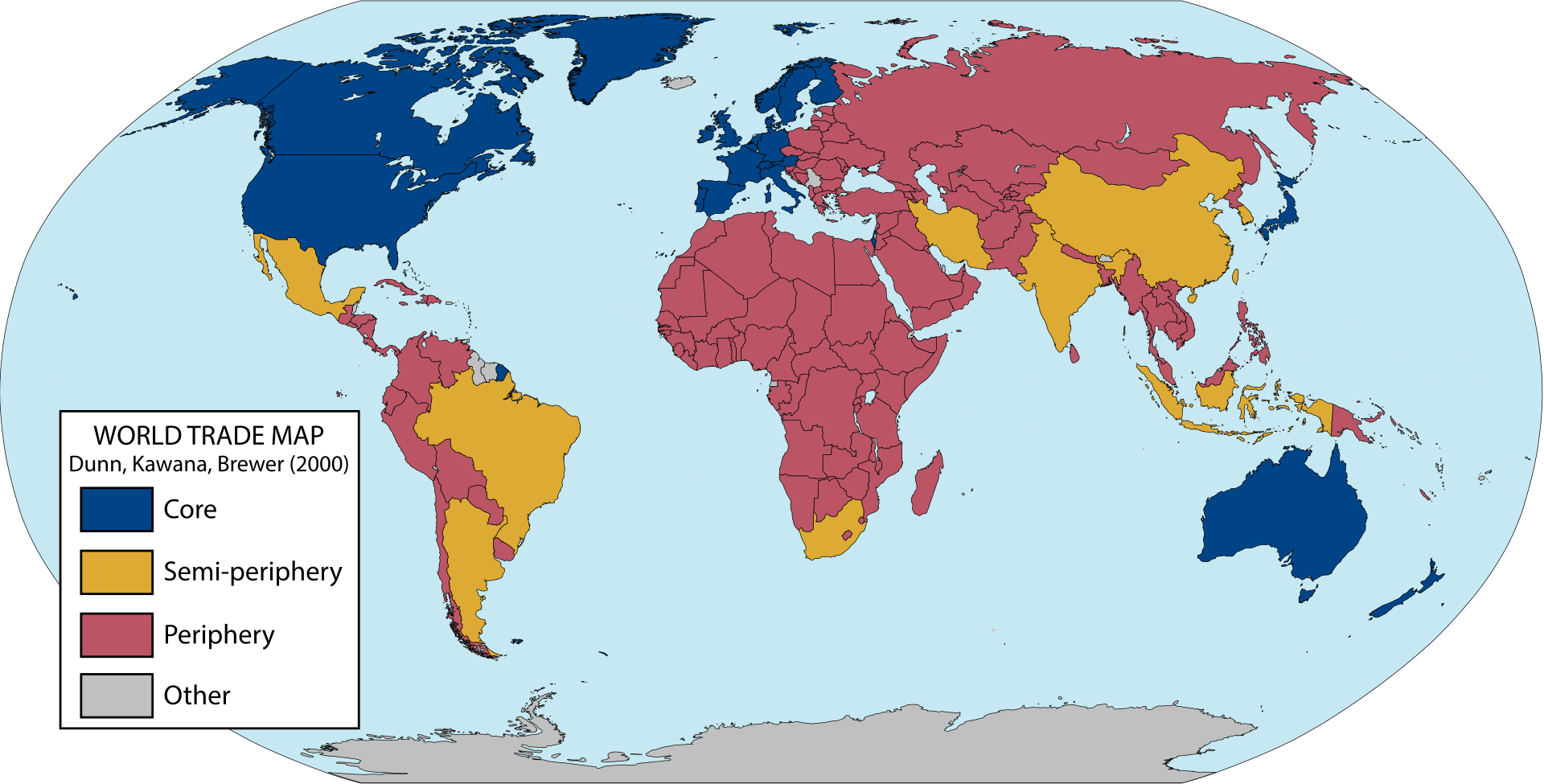
The time of rupture announced by Carney would mean that the former socialist bloc is also facing the revealed necessity of re-orientation, which confuses the hell out of its Euro-centrics. What social order would give an answer to the reign of the few over the many, and would be able to centralize ecological restoration? And who could be the international partners looking for real transnational democracy instead of dependency under imperial and colonial supremacy? In the great transition of the world-system, the East could keep on learning the hard way, forced by external circumstances beyond control, or with some semblance of planning and preparation. For its part, Romania has paid already a heavy price through the radical austerity measures imposed by the regime in the 1980s in order to align the whole economy to the absolute priority of paying the debt to the Western lenders, and then it has paid another heavy price in the post-socialist transition in order to align itself obediently into the position of a semi-periphery of the world system. For a semi-peripheral country like Romania, this moment of truth of the world-system puts into question the whole process of democratization, and in particular the form of representative democracy established after 1989. In this sense, the chaos of the Romanian presidential elections of 2024-2025 can be understood as a moment of clarification: a sign of popular anticipation rather than confusion. The discontent and distrust expressed by the majority of the people are pointing at historical truths that are getting revealed as we speak. We are witnessing a re-orientation of historical consciousness that has yet to find its political expression, because the political forces traditionally fighting and building against capitalism and colonialism have been unfairly eliminated after 1989 from the game of representative democracy. Even the year 2026 has begun in Romania with yet a new legislative initiative coming from the zealot drive of the establishment of post-socialist anticommunism, which seeks carceral and financial punishment for the public use of communist names and symbols, as well as ideas and concepts (!). The drive does remind one of the 1930s hunt in Europe to eradicate any root of communism and anarchism – and of who launched that hunt. Yet what is clear is that the popular discontent has been asking Romanians for an altogether different political form.
However, the formal political sphere continues to be occupied by the same normative binomial split between the liberal tendency and the conservative tendency. The social democrats have never really threatened it, playing in the middle, with facets of both tendencies. Currently, they are in decline, riding on institutional inertia and the power of clans, seemingly without direction. The current carriers of the liberal tendency, the Presidency of Nicuşor Dan and the mono-European government of Bolojan, are the latest caretakers of the fundamental lie. They are governing by pretending that everything will be alright after hurting the people, by trying to maintain the status quo that is only to the advantage of the big capital and the upper middle-class, while implementing no less than three waves of brutal austerity measures over one year. Thus, they are conforming yet again to the dividing and brutalizing logic of the transition to capitalism. As one should know, the tendency of a lie is only to inflate; accordingly, the extraordinary measures taken against the rise of the far-right, which directly contradicted their own principles of liberal democracy, have only strengthened the liberals’ belief in their moral supremacy and have turned into the blind fury of a radicalized and authoritarian Eurocentrism. Nothing else matters now except following even closer the same “European” directive line. The waves of neoliberal measures of austerity taken by the Bolojan government in 2025-2026 are nothing else but a mini-transition, compressing the period of sacrifices of the post-socialist transition into one more sacrificial year that “does not matter”, until the submission of the new budget of Romania to the European Commission in October 2026, looking forward to the end of the EU financial framework 2020-2027 and the beginning of the next one in 2028. Thus, in order to produce some good numbers needed for an acceptable report to the European Commission and for the rating agencies of global financial capitalism, the structural target of the neoliberal measures of austerity taken by the Bolojan government in 2025-2026 proved to be the individual consumer, the small and medium businesses and, prominently, the public employee. The big capital and the big funds are spared of being affected by the austerity cuts in the name of “prioritizing investments”, which is the direct inheritor of the term “strategic investors” used in the 1990s-2000s for the incoming capitalists who received favors giving them a leg up above the market realities. Prime-minister Bolojan refused to increase the state revenues by returning to the progressive tax or by going after the wealthy non-payers or by limiting the costs of militarization, yet has gone ham into the masses by increasing significantly the value-added tax (VAT), by increasing the annual road tax paid by individual car owners and other individual taxes, by increasing the normative number of working hours for teachers for the same pay (!) – a measure justified by saying it means “alignment to the European standards”, by freezing the minimal wage, the wages of the public sector and the pensions (!!) in the context of producing the rise of prices, by cutting the bonus for working in hazardous or harmful conditions (!!!), and even by cutting the pay for the first day of every paid medical leave (!!!!).
The pettiness of some of these measures is not just an indicator of sociopathic sadism but the structural characteristic of a new generation of politicians who know nothing about political ideologies and state matters, let alone about economic alternatives, but are mentally suffused instead in the corporatist “culture”. The current carriers of the liberal tendency in Romania are under the full delusion that the state is a corporation, namely a “badly managed corporation”, and are simply applying the capitalist definition of corporate “efficiency” to the state, without understanding the basic difference that the state has to work for the people, not for profit. They are cutting costs regardless of the interest of workers, always targeting work, not capital, down to the pettiest details hurting the common folk, and are proud of their own sociopathic version of Eliminating One Olive from First Class Salads, completely indifferent to or unaware that context is everything. These Eurocentric carriers of the liberal tendency are simply proud to be the middle management of the dependency of a semi-periphery, unaware that this is the meaning of “Europe” that they are actually conveying to the people. As in every harmful episode of the post-socialist transition to capitalism, the principle of dishing out “tough love” only applies to the masses and not to the capital or to the directing Western institutions. The tougher the love for the people, the sweeter the deal for the wealthy patrons. The real-world meaning of the word “sacrifice”, which has been predicated in the post-socialist transition to capitalism exclusively with reference to the “people”, and which has been softened and rationalized by adding the word “efficiency”, is revealed thus to be simply: exploitation. It is only common sense to expect that the current disenchantment of the people with this exploitative meaning of Europe will only continue to grow and to be capitalized by the opposition represented by the far-right pretenders to the conservative tendency. In spite of their tough posturing as “men who do what needs to be done”, the current Romanian carriers of the liberal tendency cannot avoid being seen for what they are: hapless mid-level managers who are obeying other political masters, who in turn are outside the national game of electoral democracy. They are only the latest carriers of the Western lie divulged by Carney, willingly taking the first hits of the internal distrust and division that they themselves have sowed while managing exploitation and dependency. Their only way forward is to keep on inflating the lie, blaming either an external or an internal threat.
Meanwhile, the rising right-wing pretenders to the conservative tendency are gaining popular support by pretending to address the truth. In reality, they are part of the same lie that completes the binomial and their answers are symbolic. The currently rising form of populist sovereignism is only the radicalization of the conservative tendency within the same normative political binomial of post-socialism. The radicalization itself is the direct result of trying to overcompensate the crisis and bankruptcy of neoliberalism. The sovereignist “patriots” are not a priori spared of popular distrust, which applies to the entire political class, and can be understood as the awakening consciousness or popular consensus that the post-socialist transition has been indeed a process of colonization, i.e., a loss of popular sovereignty, and that the historical time after socialism has been governed by social injustice: by lies, thefts and exploitation resulting in the ruling clique (cîrdăşie) of a few big winners and their faithful servants.
Thus, the external denudation of the world has been accompanied by internal revelations. Liberal democracy has been used in Romania to the benefit of the few. Captured Justice, the most popular investigative documentary of 2025 from Romania has shown how the justice system has been “captured” in the aftermath of the famous anti-corruption campaign led by the National Anticorruption Directorate of Romania between 2006-2012 and 2013-2018. The investigative journalists focused on the corrupt adaptation and reorganization of the justice system, particularly after 2022, and found today a “captive justice system”. The presented evidence is clear: the ultimate beneficiaries of the reorganization have been people who have enriched themselves in the post-socialist transition through theft, abuse, and fraud. The rich and powerful have been exonerated and acquitted along this corrupt process, not in the least by way of an ingeniously orchestrated expiration of liability under the existing statute of limitations. In other words, the investigation showed that the class war of the post-socialist transition has been won, some three decades later, by the rich and powerful. They are the ones who have become free with impunity after 1989, not in the least by privatizing the state and turning the justice institutions into their clients. I would add that this victory had been officially announced already through the controversial decision of the Romanian Constitutional Court from May 2025, which ruled in favor of limiting the transparency of the wealth statements of politicians.
Rather than chaos, the exposé evidences an organized order, but an order that requires increased control, militarization and surveillance, otherwise it is not sustainable. Corruption is not a local disease but a structural feature that upholds the logic of the transition. The semi-peripheral state reveals itself to be cracked, instrumented against collective action and privatized by the combined pressures of the world system and of the rich and powerful, piling up on top of the man-made climate calamities. This is the common clarity that keeps on emerging both at closer range and in the wider horizon of the world, amidst all the violence. While the liberal elites keep on pretending that there is nothing wrong with the direction of the transition, the sovereignists are reacting to the popular consensus, supported by evidence, that the transition to capitalism has been a theft, but only with vague promises of doing justice that sound like the threats of thugs, without talking at all about the gap produced and maintained between the enriched and the impoverished.
The objective reality is that the elimination of the socialist option from the East European semi-periphery has turned it into a war zone and into an area of plunder. Even the emergent right-wingers are saying out loud half of this truth. Their sovereignism is a predictable right-wing political expression that has emerged at this particular historical conjuncture out of the structural crisis of the semi-peripheral state: the right-wing responds to the deep popular discontent with mirroring indignation and the superficial means of a broken, privatized and weaponized state. At its best, the right wing looks at the cracks created by the loss of popular sovereignty through military and militia lenses, talking only about state symbols and the loss of state sovereignty. That does not make it less of a client of the world-system, or less of a servant of the rich and powerful. The elite political figures of sovereignism are just the part of middle-management who dream of promotion. I would advance this: the current form of Romanian sovereignism is the domain of the self-colonized who have temporarily lost the master and are trying to move into the void of an imagined future hegemon. The sovereignists simply cannot get rid of the dark energy of the void, which they bring wherever they show up. They must feel it themselves; otherwise, there would be no need to cover it up with pseudo-messianic rallying cries and strident promises of a golden age.
The void is the result of the objective fracture of the world-system and of the perpetual state of half-awakening of the right-wing from the state of self-colonization. Yet the only existing sovereignty belongs to the political community, otherwise called the people. Real politics would be based on the popular sovereignty which precedes any colonization or domination and provides the forces of liberation. In other times, that was the ideal meaning of work.
To sum up, the clarity emerging in the wider horizons of a turbulent world comes from the admission that the rulers of the Western world have lied and committed violence in order to maintain their advantages within the world order of colonial and imperial supremacy. Whether it was inadvertently or not, the result is the same. The global lie has given the direction of the post-socialist transition to capitalism, which has been implemented with disciplined obedience by the local managers of the lie. The lure of the coalition of “middle powers” invoked by the Canadian prime minister is, therefore, the superficial answer that tries to respond to the truth of the fractured world without correcting the course, without responding to the need for transnational democracy of the whole world, without addressing the constituency that listens to the far-right, and without actually addressing the tendency of the currently diminished Europe to slip itself into the semi-peripheral status itself. It is a weak appeal to mobilization addressed to the mid-managers of the world, who have never been known for their rebellious spirit. It is remarkable and revealing that Carney’s speech recognized the inflated lie of the Western world, but did not make an appeal for taking responsibility for its consequences! As it turns out, the banker is not even an Ivan Ilych character. Recognizing the lie does not lead to an awakened consciousness. On the contrary, the banker who recognized having managed a life of lies just pleaded for a tactical change that would keep up the charade of the status and power of the European and Canadian capitalist elites. Carney’s recognition of “the end of pleasant fictions and beginning of harsh reality” is not a return to realism, but the reaction of the coterie who has been left out of the latest scheme and realizes it has to concoct a new one. The discrepancy is striking between the “mid” range and select club of his appeal for mobilization, and the gigantic size of the lie that he has just revealed. One can contemplate, thus, the character and limits of an adult person in a position of power who has never spoken out against the lies and war crimes that were profitable for him, yet cannot accept what he perceived to be a rupture within the ranks of the Western elite. This crack within the monolith of Eurocentrism puts the middle-managers of dependency from the semi-periphery in a waiting game that is only to the advantage of the far-right.
The denudation of the world is a temporary phenomenon that encourages politicization and allows re-orientation. The politicization towards the half-baked, conservative solution of barbarism is already here, with all its dark energies. Yet we already know that in spite of claims about sovereignty, they are just future clients of the empire. The politicization toward corporate liberalism remains attractive for opportunists looking to maintain the status quo. Yet the larger world is changing, and the liberal game of complicity with the colonial and imperial forces has lost its moral pretense and it runs mostly on money. We already know that in terms of policy, all it does is to demand more sacrifices from the common folk while dishing out austerity. Within this impoverished landscape, Eastern Europe has its own resources for re-orientation in the world because it has actually experienced transformation and it has come to a point of popular disenchantment. For all its faults, real socialism has actually produced in record time social mobility at the level of the entire population, homes for everybody and an entire infrastructure for education, culture, health, energy, production and transport, adequate for the world of the 2nd industrial revolution. In comparison, after more than three decades and for all the influx of global capital, the governance of the post-socialist transition has built some roads, real estate riches and many local images to be sold to tourists, and a profuse network of supermarkets and malls, while it keeps on relying on the socialist infrastructure and on socialist-educated people. The option that would be offered by a process of socialist renewal based on the characteristics of this time and place and on the collective intelligence of East Europeans is only forbidden by the current ideological constraints. The anti-democratic nature of this interdiction should be clear by now even for the local managers of the big lie.
When even the leaders of the capitalist world are signaling the end of the post-socialist transition, it is not too late to look seriously towards the third option of a transformative left. Animated by the vision of clarity in times of turbulence, new energies of re-organizing the left have come to a common expression found in the Manifesto of the Initiative for the Right to the Future. However, one has to recognize that this is only the beginning of a beginning, which needs to be strengthened and needs a culture of solidarity and appreciation. The existing collective intelligence will have to focus on identifying and mobilizing the local and transnational resources of re-orientation that are answering the concerns of the people and are able to anchor a vision for the future. It has to be said here that not everybody has learned these truths the hard way, and that the current denudation of the world has been confirming many particular points and even the burgeoning consensus from the growing body of East European critical theory that has been expressed organically in local groups of social justice activism, in the voluminous body of work of the independent journals of leftist tendencies, and in major academic conferences such as Capitalist Transformations in Eastern and Central Europe or the four editions of the Urban Inequalities Forum from Sofia, as well as across professional associations such as the Black Sheep Society of the Association for Slavic, East European & Eurasian Studies and others. The hapless choice of learning only the hard way evidences the discrepancy between power and knowledge in neoliberal times, which has been pointed prominently in the recent blockade of the Rectorate of the University of Belgrade, organized by what is still the largest social movement in Europe.
Something is brewing in Eastern Europe, but the political space that remains to be articulated from the critical cumulation of knowledge and social mobilization would have to be able to break through the binomial reign of mediocrity of the mid-level managers of the semi-periphery. Outside this option, the much darker clarity emerging in the process of denudation of the world is that the new TINA is simply the duel to the death of the resource wars.
Ovidiu Ţichindeleanu is a Romanian philosopher, translator, and culture theorist, writing on critical social theory, decolonial thought, international politics, and the cultural history of socialism and post-socialism. His work in many independent collectives foregrounds cultural activism and political journalism in transnational, transperipheral and intercultural connections.
