


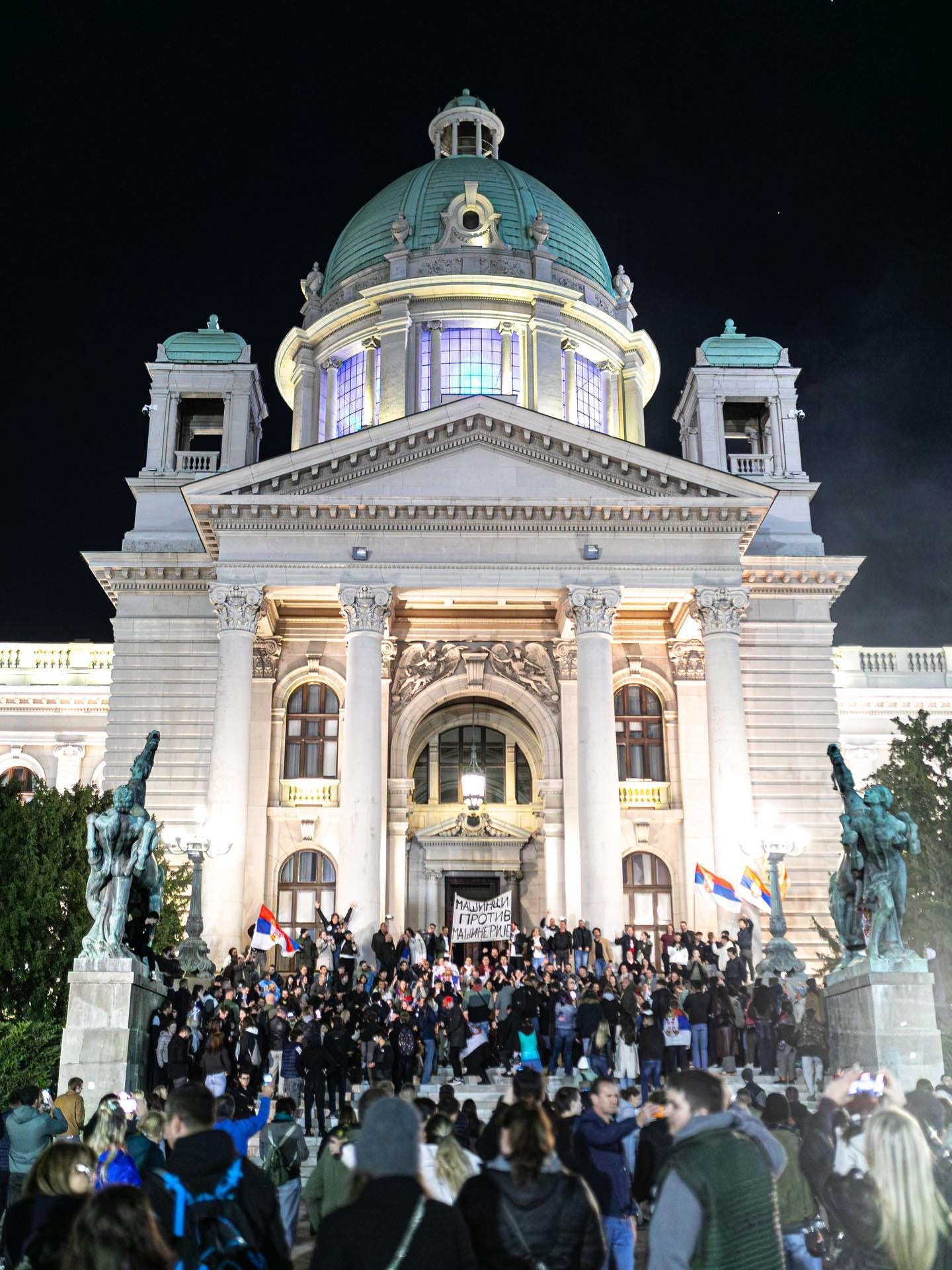
On October 25th, Serbian citizens voted in support of the massive Student Movement to end the era of Aleksandar Vučić’s autocratic rule. The Student List, chosen through student assemblies and registered as a citizens’ group, defeated Vučić’s seemingly all-powerful Serbian Progressive Party (SNS, which held power for 14 years) and won 140 of the 250 seats in parliament, with so much support from all sides that established opposition lists running separately won no seats at all. SNS-led United Serbia list got 103, and national minority lists took the remaining seven. As an Instagram joke that circulated after the election summed it up, Serbian people had defeated both the government and its opposition in one stroke. Now, there’s space for something new.
What exactly happened here?
On 1 November 2024, the canopy of the recently renovated railway station in Novi Sad, the second biggest city in Serbia, collapsed; sixteen people died – fourteen at the scene and two later from their injuries. Protests followed immediately, asking for investigation and accountability; the gatherings of protesters started taking the form of commemorative silences at major crossings in Serbian cities, sending a message that “everything must stop” for Serbian society to face all forms of violence and negligence that led to the disaster. After students participating in one of these vigils outside Belgrade’s Faculty of Dramatic Arts were physically attacked, they blockaded the faculty in protest; from there, occupations spread across Serbian universities. Their initial demands included full disclosure of documents related to the reconstruction of the Novi Sad railway station, withdrawal of proceedings against protesters and prosecution of their attackers, and increased public funding for universities. They insisted that institutions must do their jobs and that Vučić, Serbia’s president at the time, was simply not in charge of conducting the necessary investigation and handling the subsequent legal proceedings, as that is not what a president does; consequently, the sentence “You’re not in charge!” became one of the student movement’s first authentic slogans. Unsurprisingly, institutions under the ruling party’s grip failed to give a credible response, and in the spring of 2025, students demanded early elections, concluding that fulfilling their original demands required different political conditions. Vučić finally agreed to this in September 2026 and, hoping to put a stop to this once and for all, resigned the presidency to run in the parliamentary election, positioning himself for a return as prime minister. However, on October 25th, soon after the polling stations closed and the results started trickling in, Vučić went on live TV and admitted that his party lost the election – and, as it was soon confirmed, by a huge margin. Celebrations erupted in the streets, with joy that was perhaps matched only by the incredulity of the regime’s prominent clients and propagandists.
From vigils across cities to students in every village
Between those first vigils and election night lay an enormous amount of work. In the fall of 2024 and winter of 2025, occupied faculties became places where students could organize themselves: decisions were debated in plenums – assemblies open to the faculty’s students – and carried out through working groups, which reported back to the plenums, where students could review how a decision had been carried out. Keeping an occupation going meant taking responsibility for everyday needs, managing disagreements and deciding together what to do next. Researcher Aleksandar Matković recently gave a vivid account of this organization at Novi Sad’s Faculty of Technical Sciences, which he visited in March 2025: student guards controlled the entrances, screens announced plenums and alternative lectures, there were kitchens, reading rooms, carefully sorted food and medical supplies, with student nurses providing care. Discussions about political and economic questions could involve 300 to 400 students and last five or six hours. The seriousness with which students organized themselves during the blockades helped earn public trust, but also, as Luka Matić noted in early 2025, restore the universities’ social relevance; they brought urgent public problems into these alienated institutions and sought solutions collectively, all while building relationships that gave people the confidence to participate.
The movement grew in a society already shaped by successive struggles against Vučić’s rule. Ne da(vi)mo Beograd (Don’t let Belgrade Drown) had challenged the Belgrade Waterfront project and the subordination of the city to private development. Srbija protiv nasilja (Serbia Against Violence) had mobilized people after the mass shootings of May 2023, confronting the normalization of violence and its promotion by government-aligned media. Resistance to Rio Tinto’s proposed lithium mine in the Jadar Valley had connected rural communities, environmental organizations and urban protests. These struggles brought in experience, relationships and examples of collective action that the student movement could draw on.
The plenums themselves also have a recent regional history: students occupying faculties in Belgrade in 2006, protesting tuition fees and changes associated with the Bologna reforms, organized through collective assemblies. Zagreb students developed this practice during their 2009 occupations for free education, documenting it in “The Blockade Cookbook” (translated into English as “The Occupation Cookbook”), which circulated among students occupying Serbian faculties from 2024 and helped carry practical knowledge across borders and generations. Plenums, as self-organized assemblies, appeared elsewhere in the region over the last decade or so, echoing the experience of Yugoslav self-management in the idea that people can collectively make decisions, take responsibility, and create their own institutions. The 2014 workers’ protests that began in Tuzla gave rise to citizens’ plenums across Bosnia and Herzegovina, and students in what is now North Macedonia used plenums to contest higher education reforms. As a method, the plenum proved durable and effective in the Student Movement’s organizing in Serbia, embraced as an instrument of direct democracy and used to decide how to proceed with life on campus under blockade, as well as with the massive protests those blockades coordinated.
The long walks across Serbia took students’ organizing beyond the universities: in the first major march, on 30-31 January 2025, hundreds of students walked about 80 km from Belgrade to Novi Sad over two days. It retraced in reverse the journey Novi Sad students had made to Belgrade in December 1996, supporting the protests against Milošević: another tactic connecting generations of resistance. Longer journeys followed – in February, students walked from all parts of Serbia to Kragujevac, where they met for a joint demonstration and were “welcomed as liberators”; around 400 walked for four days from Belgrade alone. In October 2025, students from Novi Pazar covered more than 400 km to Novi Sad over sixteen days, one day for each victim of the Novi Sad railway station collapse. These were physically demanding journeys, especially in winter; the marchers needed food, somewhere to sleep, medical care, and protection. Communities along the routes had a chance to show up “for their children,” wherever the students came from; Milica Pekić, Vahida Ramujkić and Tatjana Rosić describe how the work of feeding, sheltering, and transporting marching students brought people along the routes into organizing themselves. Receptions in towns and villages often turned into celebrations of solidarity, making the refusals of help by government-aligned institutions even more visible and jarring. When an Orthodox bishop invited students from Novi Pazar (predominantly Muslim) to sleep at Studenica monastery, it showed they could find allies even within the Serbian Orthodox Church, whose leadership continued to stand firmly behind Vučić.
Later on, when the election campaign started taking shape, “A Student in Every Village” initiative furthered the commitment to direct encounters and political conversations in places away from Serbia’s urban centers; students from Gornji Milanovac, for example, reported discussions about water shortages, poor transport, insecure jobs and young people leaving. Residents could see how the movement worked, and students could hear what people in these communities, often treated as reliable sources of votes for the government, actually wanted to change. Meanwhile, help, support and care for the movement kept coming: teachers joined protests and strikes, farmers brought tractors to traffic blockades, lawyers offered free legal assistance, cultural workers created their own actions, IT workers organized protest stewards and support networks. Students also brought five major trade unions together around demands concerning labor and strike legislation. Supporting the students gradually became something people could organize through their own communities, workplaces, and professions. In the spring of 2025, students called on citizens to organize at the neighborhood level and form local assemblies (zborovi), providing a framework for the collective deliberation needed to support the now widespread, universal protests the students’ organizing had grown into. Eventually, all of this led to a movement capable of beating Vučić in the election. Slobodan Simović summed up its incredible feat most succinctly: “A movement born out of protests against violence and a lack of institutional accountability, organized horizontally, with no conventional leadership, no coalition with existing opposition parties and no identifiable powerful international backer, managed to win an absolute parliamentary majority under its own name and brand.”
How the Student List was built
At the beginning of 2026, as faculty occupations subsided, students began setting up campaign headquarters, training election observers, and continued meeting residents. Already on December 28th, 2025, they reportedly collected nearly 400,000 signatures in a single day in support of early elections, with many of the signatories sharing contact details and offering to participate in future activities; almost ten months later, such wide support showed up as the capacity to monitor and defend the voting process against the usual manipulations. Electoral organizing also worked across borders: the Student List ultimately won almost 73% of valid votes cast abroad, despite substantial barriers to participation. CRTA reported that polling stations had not been opened in nineteen cities that met the registration threshold, and that the journeys required of the 4,824 voters assigned elsewhere would collectively exceed fifteen trips to the Moon and back. Diaspora volunteers responded by connecting voters with possible hosts and mapping options for traveling together; getting people to the ballot box became another undertaking sustained by practical solidarity.
Putting together the Student List for all these voters to support took more than a year. More than eighty faculty plenums across six university centers helped select its 250 candidates, with places distributed to ensure representation beyond Belgrade. Current students were ineligible, as were former members of the governing parties and past or present officials of parliamentary opposition parties. Plenum nominations were followed by interviews, scrutiny of candidates’ records, and rounds of verification – any plenum could raise an objection to a candidate and challenge the nomination, while removing that candidate required agreement from more than half of the plenums. As Matković recalls, his candidate interview involved around 300 students, with phones left outside to prevent any details from becoming public and preserve the interviewee’s privacy for as long as possible. Accounts of the process show disagreements, reconsideration and communication failures, alongside considerable patience and goodwill; nevertheless, it is also evident that a serious and sustained effort was made to determine who would represent the movement through collective judgment, rather than personal connections or privileged negotiations between powers that be. Every nominated candidate signed a declaration promising that, if elected, they will stay in the parliamentary group, work to meet the students’ demands, and refrain from voting for measures that contradict the List’s program; the declaration treats a breach of this promise as a resignation. With this, the students have put the movement’s expectations of its representatives in writing: how much weight that will carry will depend on the MPs honoring their word – and on people outside parliament being able to hold them to it.
The list was deliberately designed to accommodate substantial political differences. Reporting on the selection process describes an agreed constitutional baseline, including the provision which treats Kosovo as part of Serbia, alongside opposition to religious and ethnic hatred and respect for candidates’ different identities. Within those boundaries, people from the left, liberal and conservative traditions could participate, understanding that their common goal is to confront and end a system of unchecked power and lawlessness. That breadth extended to the Student List’s supporters – opposition parties from across the political spectrum endorsed it, alongside environmental movements, local initiatives, civic networks and conservative organizations. The students accepted support, but retained authority over candidate selection and the direction of their campaign.
The prominence of academics and other professionals prompted Science’s “world’s brainiest parliament” headline in the immediate aftermath of the election; it also raised concerns regarding the new parliamentary group’s lack of political experience and risk of creating another public institution ruled by elites and subservient to the dominant economic order. The possibility of elite capture certainly deserves vigilance – the Balkans have a long and painful history of suffering under technocrats – but treating it as a foregone conclusion overlooks the processes and relationships that shaped this list. The students’ movement is made up of young people coming from all parts of society; their organizing connected university cities with small and rural communities facing poverty, exploitation, and depopulation, and their candidates – of various ages, professions, and political convictions – were scrutinized for their public conduct and alignment with the movement’s demands. This, of course, does not make them immune to the structural conditions and multifaceted pressures of their new position in the Serbian Parliament - but it does create an opening for more than politics-as-usual. Among the incoming MPs are Goran Perišić, a longtime Kolubara mineworker active in union organizing, Zoran Stojiljković, a former president of the “Nezavisnost” trade union confederation, and Zlatko Kokanović, a farmer who helped organize against lithium mining in the Jadar Valley. What meaning and power their ties will have in the future constellations of Serbian politics remains to be seen, but it would be shortsighted to deny that unions and rural communities could use those ties to press for their own demands once parliament is constituted.
With the program that stresses independent institutions, stronger public services, workers’ dignity (including stronger protection against retaliation for union representatives and explicit recognition of the right to strike in solidarity with other workers), community, solidarity, and environmental protection, pledges to “abandon the policy of presenting Serbia as a source of cheap labor,” and promises support for domestic production and predictable conditions for business, this project is about exploring what sorts of political and economic developments might be possible in a society freed from autocracy. Pointing to the campaign’s efficiency, a report in the Financial Times called the students’ movement a “very powerful group” – and the only apparent source of that power is the persistent, successful organizing around a purpose strong enough to sustain cooperation across political differences.
After the vote
The immediate tasks include forming parliament – the constitutive session is scheduled to convene on November 17th (which, in a fitting coincidence, is International Students’ Day) – and holding a presidential election, due by December 27th. Some institutions began acting differently well before the actual change of government, as expectations of political protection weakened. The days after the election brought inspections of prosecutors’ offices, the withdrawal of ALTA Bank’s operating license, and arrests of senior police officials. A website tracking arrests, criminal complaints and resignations went live the day after the election under the name “System Collapse.” Prominent figures on the Student List are promising extensive investigations, with priorities including financial forensics, scrutiny of public assets and accountability for violence against protesters, as well as alleged connections between political power and cross-border organized crime.
Newly elected Serbian MPs are also announcing a new era of good relations with neighboring states and respect for their sovereignty; on Kosovo, the Student List takes a separate position, maintaining Serbia’s constitutional claim to Kosovo and opposing its independence. The List supports continuing European integration, with membership ultimately decided by referendum, and intends to preserve military neutrality and maintain Serbia’s refusal to impose sanctions on Russia, while affirming Ukraine’s territorial integrity; after the election, EU enlargement commissioner Marta Kos welcomed the possibility of a fresh start but warned that Serbia’s refusal to align with the EU on Russia would stand in the way of accession. On Gaza, the new parliamentary majority rejects complicity in Israel’s destruction of the Palestinian people and pledges to increase humanitarian aid. An early test of that commitment will be whether the new government halts arms exports to Israel, which rose sharply under Vučić.
The new government will have plenty of decisions to make, and people can hardly wait. Neighbors have immediately started getting together to clean up their streets, remove offensive graffiti and dance while they do it. As the movement’s running joke goes, “Don’t let anyone ease tensions!” That appetite for taking an active part in collapsing the former and building a new system could be channeled into ongoing organizing – through new forms of civic participation, for lasting political change. Here, the joke about holding onto the tensions becomes relevant again, especially after the victory: people will need to be willing and able to take up the disagreements they set aside to defeat Vučić, even when that means organizing against a decision made by the people they helped elect.
What would count as change?
What kind of change can be imagined and won depends on how we define what needs to change. On the day the canopy collapsed in 2024, researcher, activist, and trained architect Iskra Krstić wrote a short piece offering the sharpest analysis of what just happened: “Deregulation kills.” This is vastly different from saying “corruption kills”; it directs attention towards the systems of austerity capitalism and neoliberal urbanism that, infuriatingly, work exactly as they are designed to work – through dismantling of procedures, planning institutions and professional oversight in the name of facilitating investment. It is of utmost importance to remember Krstić’s diagnosis now, because just as investigating corrupt wrongdoing is necessary, so is examining the rules – laws, plans, exemptions, etc. – that allow common interest, public safety and collective needs to be subordinated to private profit entirely lawfully.
The students’ post-election statement against forced evictions gives a sense of what rewriting those rules might mean. It calls for a halt to planned evictions in Belgrade and argues that the right to a home and to dignity should come before private profit. The students want the state to protect people’s homes by changing a system that lets enforcement officers exercise public powers while earning income from debt collection. The List’s program also proposes keeping public housing in public hands and expanding affordable nonprofit rentals, a decidedly leftist commitment if you’re still reading this text searching for one. So is solidarity with Palestinians; on the other hand, the List’s position on Kosovo is harder to square with self-determination. What matters here is that these positions sit together in a program shaped from the bottom up, through organizing that reached from universities into workplaces, neighborhoods, and villages across Serbia; it reflects what people with very different politics were able to agree on in the course of this struggle. Traditions of left organizing in the region helped make those agreements possible, and those of us on the Left – in Serbia, post-Yugoslavia, Europe, the world – who want to go further have our work cut out for us after October 25. We have to turn our criticisms into demands and build the alliances that can win them.
I follow these developments from Portugal, as a Montenegrin citizen, activist, and researcher with deep friendships and longstanding collaborations in Serbia. I supported the opposition that defeated Montenegro’s Democratic Party of Socialists in August 2020, after it had governed for practically my entire life, and have seen up close how a great electoral breakthrough can fall short of the political, economic, and social transformation people hoped for, when patronage networks and their sway over institutions survived the change of governing parties. In short, and somewhat obviously, removing entrenched leadership is just a small step in the struggle to actually change how power is distributed, and to what ends it is exercised.
Here in Portugal, police have been forcibly dispersing protests demanding the right to housing. Against that background, I find it encouraging how plainly the Serbian students show – just as the List they put into Parliament is about to take power – whose needs public institutions should protect. The difficulty of turning political victories into better living conditions extends far beyond Serbia; it is part of a much wider political crisis. Across interconnected economies, extraction and the deregulation that enables it have long been treated as the immutable facts of our collective neoliberal destiny, beyond the reach of the ballot box. But something new must be coming: besides Vučić’s defeat in Serbia and youth protests everywhere, Lula’s recent re-election in Brazil and the Democrats’ gains in the U.S. midterms clearly show that people everywhere need change. However, securing housing, decent work, public services, and environmental protections will continue to be impossible without changing the entrenched economic dependencies that constrain elected governments, no matter how nominally progressive and well-intentioned. In other words, the questions of whose interests the economy serves and whom the law protects remain as relevant as ever, and we still have much analytical, organizing, and mobilizing work to do if we want to arrive at answers that center community, life, and care.
In January 2025, Luka Matić saw the students’ demands for transparency, accountability, and the power to remove those in office as a challenge to concentrated, arbitrary authority. He called the opening this created a “positive uncertainty”, and it still describes Serbia’s situation. What happens next depends on people staying involved and hopeful enough to work through deep disagreements and continuing to participate in shaping a future whose outcome is still undecided. The students have shown how the capacity for this kind of work grows through the everyday acts of meeting, arguing, and looking after one another. I cannot wait to see what Serbian society does with the space it has opened, and what we learn from it.
Sonja Dragović is a PhD candidate and researcher at DINÂMIA’CET-Iscte in Lisbon. She studies how social movements and activist practices challenge spatial planning decisions and influence urban policy in post-socialist contexts and beyond. As a member of KANA/ko ako ne arhitekt and Green Kolašin in Montenegro, she has long worked with local communities to develop participatory and insurgent approaches to planning, analyze and shape public policy, and support shared spaces.

Great and useful analysis. Thank you for writing it