


Red Threads is born at a moment when the present cannot presume superiority over the past. The reintegration of the postsocialist region into global capitalism has materialized not as liberation, but as poverty, ecological destruction, racism, and war. The false promises of the 1990s now pale before the transformative and universal aspirations of the socialist projects of the twentieth century. Their contradictions have left unfulfilled potentials for the future.
Red Threads calls on the legacy of twentieth-century socialism in all its complexity: its achievements, failures, and unrealized futures. In the face of denial stand its world-historical accomplishments: the raising of living and educational standards throughout the region; the skilling of millions of workers; the inspiration of revolutionary and reformist movements throughout the world; the construction of physical and social infrastructure, which still, despite decades of neglect, enables survival; and, above all, the victory over fascism. What were for the socialist project its own contradictions, to be resolved dialectically towards the horizon of communism, became easy indictments of the entire project in the postsocialist period: enduring and new social inequalities, flailing political mobilization that eventually required harking back on nationalist tropes, continued use of state violence, the routinized forms of socialist democracy. Red Threads maintains that these contradictions of the socialist project must be faced militantly, not apologetically. Our commitment is to immanent criticism, one that holds the socialist project up to its own demanding criteria, while reaffirming its aspirations. This is also the way to reckon with the bitter disappointment and material losses of the region’s working classes, which are expressed sometimes in the politics of resentment and other times in nostalgia for an alternative.
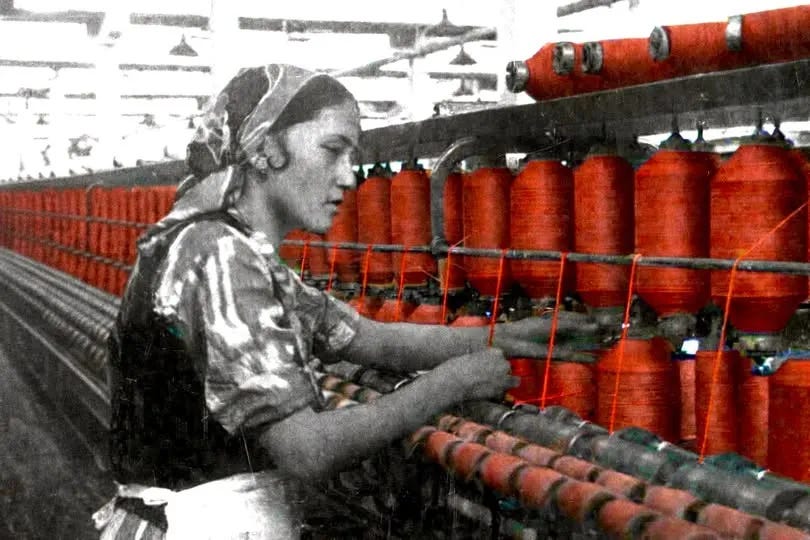
In a salute to the socialist legacy, Red Threads takes its name from the Petrograd textile factory «Красная нить», where women workers stood at the forefront of revolution, and from the “red thread” invoked by Luxemburg and Lenin as a through-line of history. A thread weaves and binds; it is in constant motion. Our threads are multiple and open-ended; we seek to weave together the realized and interrupted horizons of the revolutionary legacy into our daily reality and our visions of future political forms.
Universalism from the East
We conceive of our distinctive contribution as a Universalism from the East. This is at once a geographical and a political-theoretical position, a reclaiming of the struggles for and within twentieth-century socialism. Both proximate to the capitalist heartlands of Western Europe and subordinated to its imperial power, the revolutionary protagonists of our region sought to produce universally valuable knowledge from their contradictory conditions. Their position enabled them to engage with and intervene in Marxist debates with utmost seriousness and to recognize that the very process of capital accumulation reproduces unevenness and that capital’s false universality itself produces heterogeneity. That insight generated home-grown vocabularies and creative revolutionary practices and institutions that the world still has much to learn from. We proudly inherit from them this task.
The task of universalism from the East is a practice in concrete universalism, which requires that deep political principles are not abstracted from but are concretely conceived within the history, experience, and reflections “from the region to the world.”
Actually existing socialism and socialist aspiration belong to one historical field of struggle. To split them too neatly and treat one as an alien deviation from the other serves to protect present-day desire for a communist future from the burden of life itself: from contradiction and complicity, from the messy and bleeding conditions in which collective futures are made. If one part of the courage to make history under conditions not of our own choosing is to admit that history is never pure, another part is to admit that responsibility, accountability, and learning must be shared as well.
Our political principles here reflect this dialectical relationship between theory and history.
As socialists committed to a communist horizon, we believe in the creative power of ordinary people to shape history, and in their capacity to undertake a democratic organization of material production, social reproduction, and cultural and intellectual life.
Taking reality as a totality in which parts and whole are mutually constituted through internal relations, we hold that the struggle against capitalism cannot be divorced from the fight against racism, imperialism, colonialism, and hetero-patriarchy.
Capitalist production of surplus value is antagonistic to the reproduction of life. This antagonism is not merely a logical contradiction: the totality of ecological-material relations and life processes on the planet is the precondition of all social relations, and sets natural limits on human activity.
We, thus, understand class in an expansive sense, one that encompasses relations to the means of reproduction as well as production. We reject any rigid distinction between exploitation and oppression and offer unconditional support for the liberation of all oppressed groups.
The primary enforcer of capitalist violence is the capitalist state, and at the global scale, the imperial state. We reaffirm the need to analyze imperialism, a category central to the political thought of revolutionaries in our region. As we witness the precipitous decline of the American Empire, we commit to the renewed task of understanding imperialism, and to solidarity with all peoples subjected to occupation, colonization, ethnic cleansing, and genocide. Recognizing the right of such peoples to armed liberation struggle, we also note that militarism reinforces capitalist violence, and that the price of war is always paid by the most vulnerable and least guilty. We thus affirm the internationalist value of peace.
We recognize state-socialist achievements in the fight against imperial, patriarchal, racial, and colonial oppression. And this requires us to take seriously the problem of how the criticism of oppression has been de-materialized and instrumentalized for imperialist, anti-communist, and nationalist purposes in the post-socialist era.
In contrast to the liberation struggles of the early 20th century and the anti-colonial movements in the post-war period, today, in the context of deep neoliberal reforms and erasure of legacies of socialist knowledge production, nationalism in our region has played not a liberatory or anti-imperialist role, but a reactionary and imperialist one. There is a lot to learn from this phenomenon in the East for the global left.
Finally, these trajectories are rooted in the intentional repression of communism in the post-socialist region and the outright criminalization of socialist histories and ideas in the name of national sovereignty, as well as the integration of many successor Communist parties into right-wing regimes and their appropriation of communist symbols, images, and slogans. As a result, the level of theoretical debate and engagement with communist ideas—as ideas for social progress and liberation for all—has suffered immensely. We celebrate and support the rediscovery and reappropriation of communism by the younger generation of intellectuals and workers in the region.
Our invitation
As a successor project of LeftEast, Red Threads is a multi-tendency left collective: less than a party, but more than a magazine. We publish together in order to think together, to reflect on evolving questions, and to maintain dialogue between distinct left traditions. We aspire to a socialist politics together that is attuned to the current moment while drawing lessons from the past. However, we invite a demanding, comradely, collective conversation that begins from common principles and arrives at collective action.
As a publication, we welcome contributions from anyone who shares our political orientation. In furtherance of a universalism from the East, we invite contributions relevant to socialist political analysis and strategy, theory and history, past, present, and future. We provide our linguistic and editorial skills in support of perspectives from the ground that require more than translation, but the careful rearticulation of the academic and political language to which they are addressed. We are committed to working closely with contributors to sharpen political clarity and improve textual quality.
We intend to give pride of place to the post-socialist world, as well as to the socialist traditions of the Global South, which are still little known in Eastern Europe despite the deep links between our histories and present struggles. That said, we will also continue conversations with comrades in the West, including with diasporic socialists who had to leave our region.
In order to facilitate communication across post-socialist contexts, we will begin by publishing in English, but we aspire to expand into other languages in the near future. We welcome submissions by non-English speakers in their own languages, which we can appraise for translation and publication. Please see our Submissions page for more details, and never hesitate to get in touch with us with questions or feedback.
Wonderful and inspiring opening editorial.