


Introduction: The Anatomy of Far-Right Terror in the Context of a Socio-Political Crisis
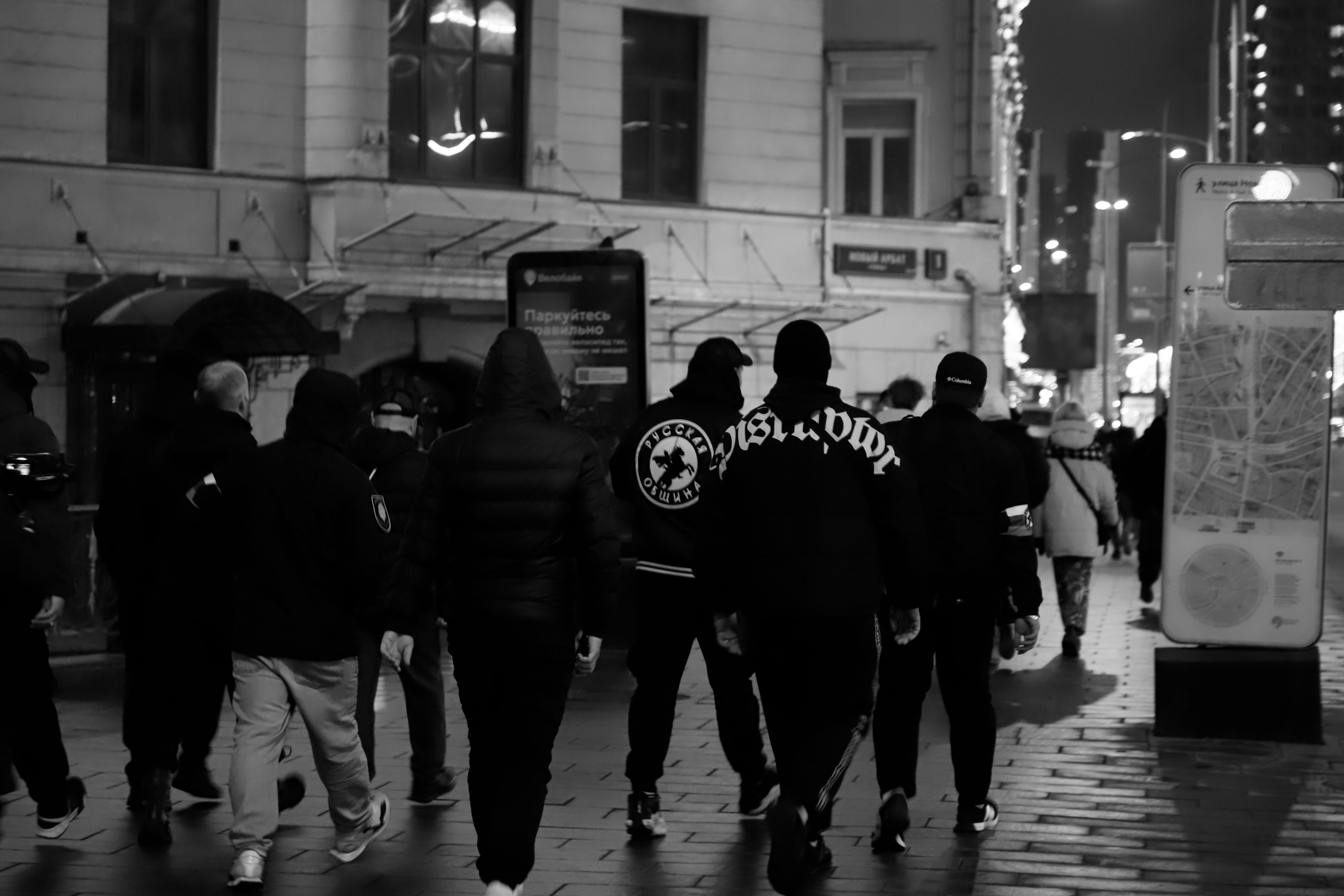
The year 2025 became a major milestone in the recent history of the Russian far-right. We witnessed an unprecedented bifurcation of the movement: on the one hand, there was the profound institutionalization and legalization of the moderate-radical wing. Through structures such as the “Russian Community,” “Northern Man,” and organizations affiliated with the far-right oligarch Konstantin Malofeev, this wing began to actively integrate into the legal political arena, claiming the role of an unofficial moral police force and parallel security structures. On the other hand, the subcultural neo-Nazi wing, driven into the digital underground of the Telegram messenger, has radicalized, shifting from pettyhooliganism to brutal murders and school shootings.
This polarization is not accidental; it is the result of highly complex sociopolitical processes unfolding against the backdrop of an ongoing armed conflict, growing social frustration, economic turbulence, and artificially stoked anti-immigrant hysteria. State migration policy in 2025 took on a distinctly restrictive. 2025 saw the adoption of the Concept of State Migration Policy for 2026–2030,[i] the creation of a registry of persons under surveillance,[ii] including more than 770,000 undocumented migrants, the introduction of bans on foreign workers in various economic sectors at the regional level as well as strict educational requirements for migrant children.[iii] Аll this legitimized xenophobic discourse in the public sphere and demonstrated the influence of the far-right agenda on the political process. At the same time, according to opinion polls, public concern over the “migration threat” dropped to third or fourth place in 2025,[iv] and the Ministry of Internal Affairs in a 2024 report recorded a continuing decline in criminal activity among foreigners—they commit only 2% of crimes in Russia.[v]
Nevertheless, Russian officials and State Duma deputies have continued to normalize once-marginal ethno-nationalist rhetoric. Alexander Bastrykin, the Head of the Investigative Committee, has emerged as a key patron for groups like “Russian Community” and “Northern Man.”[vi] He advocates for draconian migration reforms, including mandatory genomic registration, replacing foreign labor with locals, and revoking citizenship for naturalized migrants who evade military service.
This state-backed normalization signaled to the far right that their ideology is valid. However, this instrumentalization radicalism led to consequences beyond state control. Street vigilantism—initially joint police-nationalist raids—evolved into autonomous terror. Unpunished actions by the “Russian Community,” such as the fatal May 2025 Vsevolozhsk apartment raid and harassment at Nemchinovka station, created a climate of lawlessness.
This environment radicalized youth through a synthesis of official propaganda and Telegram-based neo-Nazi subcultures. The “gamification” of violence culminated in the December 2025 Gorky-2 terrorist attack: 10 km from the presidential residence, a 15-year-old student, emulating Brenton Tarrant, livestreamed the murder of a 10-year-old Tajik boy.
This article presents the results of a comprehensive analysis we undertook of the various structures of and developments in the Russian far-right. We start by examining the main trends in racially motivated attacks: their overall number in 2025 plateaued , but the targets shifted increasingly to Indians and Africans. Secondly, we consider the factor of the war, which created new far-right spaces such as the now-dismantled military unit “Española.” Thirdly, we examine the role of oligarchs in promoting the far right using the case of the prominent Orthodox businessman Konstantin Malofeev and his media network. Fourthly, and perhaps most gruesomely, we examine in detail the terrorist attack in Gorky-2, in which a 15-year-old neo-Nazi student stabbed a 10-year-old Tajik boy to death under the influence of far-right channels on Telegram. Finally, we look at the integration of the far-right agenda into state politics ahead of the 2026 State Duma elections. We conclude that if the state continues its policy of tolerance, if not outright encouragement, of the far right while suppressing left-wing opposition, this will pose existential dangers to the multinational Russian society.
Section I. The Radicalization of Street Violence and the Typology of Victims
To gain a comprehensive understanding of the evolution of far-right violence in the Russian Federation in 2025, it is necessary to examine the empirical data collected by the independent research project NVMP (Nazi Video Monitoring Project).[vii] This project conducts daily monitoring of over 200 neo-Nazi Telegram channels for violent videos. The results for 2025 paint a frightening picture: following an explosive surge in 2024, when 1,099 attacks were recorded (compared to 611 in 2023), the curve of violence has reached a plateau. In 2025, the NVMP verified 1,107 incidents of attacks.
Despite increasing pressure from the police and numerous arrests, the neo-Nazi movement managed to maintain the level it had reached in 2024, the peak year of the decade.
Sensing the threat, the radicals changed their tactics: they became more cautious about posting videos of criminal offenses, started carefully concealing faces, blurring geolocation markers (signs, license plates), and delaying the publication of content by several weeks so that recordings from city surveillance cameras would have time to be deleted.
The stabilization in the number of incidents was accompanied by a catastrophic increase in the level of violence. The year 2025 marked the highest number of racist murders in recent decades—researchers are aware of six confirmed cases of people killed by neo-Nazis in Russia, but this list is likely incomplete. While in previous years attacks were more often limited to the use of pepper spray or beatings without weapons, the arsenal of street neo-Nazis has now been expanded to include hammers, knives, brass knuckles, and flare guns, which they deliberately fire into their victims’ faces (as in a high-profile case in Kostroma, where a young man lost an eye,[viii] and in a series of attacks in the Novosibirsk MZhK).[ix]
An analysis of the typology of victims reveals extremely alarming trends. Historically, the main targets of Russian skinheads have been people from Central Asia and the Caucasus. In 2025, this trend persisted—80% of attacks are still committed against people with a “non-Slavic phenotype.” At the same time, 2025 was marked by a sharp, statistically anomalous surge in violence against new categories of migrants, particularly those from India and Africa arriving in Russia as students or workers. The most striking example of this trend was the case of a gang of teenage neo-Nazis in Ulyanovsk.[x] On February 7, 2026, in Ufa, a 15-year-old teenager, Alexander S., who, according to media reports, had been recruited by the terrorist neo-Nazi organization NS/WP, broke into the dormitory of Bashkir State Medical Universityand attempted to carry out a mass killing of students from India.[xi] As a result of his actions, four Indian students and two police officers were seriously injured. On the wall of the dormitory, he drew a swastika with the blood of one of his victims.
Another specific category of crimes has been attacks on members of the LGBTQ community (recognized as an extremist ‘organization’ in the Russian Federation and banned in 2023) through the mechanism of “staged dates.” In the fall of 2025, members of a gang of neo-Nazis operating in Moscow were detained,[xii] and in St. Petersburg, similar “gayhunters” shot a 42-year-old man in the head with a non-lethal pistol in Murinsky Park.[xiii] This type of violence demonstrates how the far right uses the conservative state agenda—the fight against LGBT people—as a legitimizing cover for petty robbery and the satisfaction of sadistic tendencies.
In addition, about 10% of the victims of far-right terror are political opponents—anti-fascists and representatives of left-wing movements. For example, in January 2026 in Yaroslavl, neo-Nazis attacked a group of teenagers, among whom was a member of the Leninist Communist Youth Union (LCYU), having specifically tracked him down using photos from Communist Party of the Russian Federation (CPRF) events.[xiv] Previously, in 2024, Yaroslavl had seen repeated attacks by neo-Nazis on young communists.
Finally, a counterintuitive but symptomatic trend of the contemporary street neo-Nazi scene is an attack on the property of citizens openly demonstrating support for the Special Military Operation. This refers to widespread incidents of slashed tires, smashed windows, and arson attacks on cars bearing “Z” and “V” stickers. While the far-right pro-government groups swear allegiance to the state and position themselves as ultra-patriots, the radical neo-Nazi underground, represented by NS/WP and affiliated cells, holds hardline anti-systemic, accelerationist positions. For them, the Russian Federation is perceived not as a nation-state of Russians, but as a “multinational neo-Soviet tyranny”.
It is important to emphasize that the Telegram messenger remains the only infrastructure and the main hub for the neo-Nazi underground in Russia despite the arrest of the creator of the “Razgrom” channel and the dismantling of the “Village Club” network.[xv] By early 2026, the scene had become fully decentralized: content and audiences had dispersed across a multitude of smaller channels (5,000–8,000 subscribers). The large-scale blocking of Telegram in Russia, which started in April 2026, will likely deal a critical blow to this ecosystem.
Section II. The Fall of “Española” and the Collapse of Far-Right Military Units
The war against Ukraine has offered the Russian far right plenty of organizing space, but the fate of its military units has also demonstrated the incompatibility of the radical, semi-criminal subculture of soccer hooligans with the objectives of a regular army. The state’s attempt to cozy up to the far right resulted in the creation of heavily armed mafia-like structures that posed a threat not so much to an external enemy as to internal security.
The most famous such unit was “Española,” formed in the spring of 2022 as part of the “East” brigade. Behind the “Española” military unit’s (the 88th Volunteer Brigade) creation in 2022 was Stanislav Orlov, nicknamed “The Spaniard”—a prominent fan of Moscow’s CSKA —who had experience participating in combat operations in Donbas since 2014, where he earned his nickname for his knowledge of foreign languages.[xvi]
Modeling itself on the institutional success of the Wagner PMC, the leadership of “Española” initially sought to transform the brigade into a PMC. However, the Wagnerites’ failed armed mutiny in the summer of 2023 forced the unit’s commander (Orlov) to abandon this notion. Since 2023, recruitment for “Española” has been organized through the “Redout” PMC, which is linked to Russian Railways (RZD) structures and personally to RZD Security Chief Viktor Shendrik. The company had become interested in the possibility of creating a private army for themselves, consisting of far-right soccer hooligans.[xvii] The ideological foundation of “Española” was built on a specific mix of Russian neo-Nazism, militarism, and hooligan culture.
Throughout 2023–2024, “Española” actively built its media brand, positioning itself as an elite, ideologically motivated unit, free from military bureaucracy. However, behind the glossy facade of propaganda videos (the so-called “TikTok troops”) was widespread drug use (mephedrone), which led to the loss of expensive equipment. Orlov himself reportedly told journalists about the discovery of an underground drug lab in a cowshed near Horlivka back in the spring of 2022.[xviii] At the same time, military correspondent channels reported that Orlov had seized a lab near Mariupol, and later began using the drug himself.[xix]
The situation began to spiral out of control in the spring of 2025, when massive financial embezzlement and illegal arms trafficking were uncovered. In December 2025, the state apparatus, weary of the uncontrollability, ideological toxicity, and outright banditry of “Española,” decided to crush it. During an FSB operation near Sevastopol to apprehend Stanislav “The Spaniard” Orlov was killed.[xx] Just three months before his death, Orlov had received an “honorable retirement” and was appointed president of the All-Russian Association of Fans.[xxi] Orlov’s mysterious death was not discussed at all in the Russian media, and those involved chose to remain silent. The unit was officially disbanded; some of its members were arrested, while the remaining fighters announced their transition to the “Russian Community“.
But “Española” was far from the only such instance of a Russian military unit fighting in Ukraine with far-right links. The 106th “Svetloyar” reconnaissance detachment was originally presented as an elite project of imperial nationalism. In 2023, the detachment was launched with massive financial and media support from the structures of far-right oligarch Konstantin Malofeev: he literally clothed and shod the soccer hooligans with his own money, and then blessed them for war.[xxii] It was assumed that “Svetloyar” would become the combat vanguard of the emerging “Black Hundred International.” However, in 2025, this alliance collapsed when the leadership of “Svetloyar” publicly renounced its affiliation with Malofeev and his “Tsargrad” structures amid news of the Spaniard’s death.[xxiii] According to monitoring groups, the rift was caused by a conflict over the distribution of resources and the frontline fighters’ unwillingness to serve as a “pocket army” for the oligarch. The loss of elite patronage led to a sharp decline in supplies to “Svetloyar,” an exodus of media volunteers, and the gradual dissolution of the unit into regular army structures. Since November 2025, the 106th Unit’s channels have not been updated.[xxiv]
An even more telling development was the decline of the “Rusich” Special Forces Unit—a unit that openly espoused neo-Nazi ideology and enjoyed unquestioned authority among radical right youth. In 2025, the group faced two critical blows that destroyed its image as “uncompromising white warriors.” First, in March 2025, a Finnish court sentenced one of the founders and ideologues of the unit, Yan Petrovsky (Voislav Torden), to life imprisonment on charges of war crimes.[xxv] The Russian state’s inability (or unwillingness) to secure the extradition of such a toxic figure, combined with state officials’ silence on the matter, clearly demonstrated to neo-Nazis the limits of the official support they could count on.
Second, a fatal blow to “Rusich’s” reputation in far-right circles was their public reconciliation with the commander of the Chechen special forces unit “Akhmat,” Major General Apti Alaudinov, in January 2025.[xxvi] The “Rusich” case exposed a broader state strategy: the use of Alaudinov as a universal tool for pacifying the far right. Acting as an agent of federal control, Alaudinov pulled off an unprecedented political maneuver in 2025. First, he supported the creation of the “Community of Friendship of Peoples,” loyal to the authorities—a counterweight to far-right radicals and an expression of official Russian multinational discourse[xxvii]—and then agreed to join the board of trustees of the “Russian Community South,”[xxviii] which had split from the main “Russian Community” and formed an independent movement.
Section III: Institutionalization Under Malofeev’s Wing
The year 2025 was marked by an unprecedented attempt to consolidate, institutionalize, and politically legalize the far-right movement in Russia under the auspices of structures affiliated with the above-mentioned Orthodox oligarch Konstantin Malofeev. Previously viewed primarily as a sponsor of separatist movements in Donbas in 2014, by 2025 Malofeev had transformed into a figure of national, and to a certain extent international, stature. Possessing colossal financial resources, a media empire—the Tsargrad TV channel and website—and strong ties to the conservative segment of the political elite and the Russian Orthodox Church, Malofeev set himself an ambitious goal: to unite the fragmented far-right, monarchist, and conservative forces into a single, powerful bloc capable of dictating its agenda to the state and serving as the vanguard of the “Traditionalist International” in Europe.
Malofeev’s strategy is based on a multi-level approach. Within Russia, his organizations—such as the historical society “Double-Headed Eagle” (later renamed into the “Tsargrad” movement), the student “Brotherhood of Academics,” and the paramilitary “Russian Brigade”—serve as a legal front for recruiting and indoctrinating young people. Malofeev’s organizations actively compete for influence with other far-right projects, primarily with the mass-based “Russian Community.” Thus, following a conflict with the leadership of the “Russian Community,” Malofeev initiated the creation of the spoiler organization “Russian Druzhina,” which not only copied its competitors’ symbols and tactics—going so far as to create its own mobile app with an “SOS panic button” to summon militants to sites of interethnic conflict—but also attempted to poach the most radical activists into its ranks.
The symbiosis of Orthodoxy and far-right violence within Malofeev’s structures is systemic. The mixed martial arts clubs under his control, united in the “Double-Headed Eagle” Federation of Traditional Sports, function de facto as training bases for street stormtroopers. A telling incident occurred in Yekaterinburg, where in April 2025, Nikita “Bormann” Manaenkov, a member of the local “Double-Headed Eagle” club, brutally stabbed two sleeping homeless people to death in the city center, filming the attack on his phone.[xxix] The head of this club, Petr Kolesov, covered in Nazi tattoos, openly used infrastructure funded by Malofeev to cultivate neo-Nazis.[xxx] Moreover, the very same 106th Reconnaissance Detachment was formed from the ranks of activists in these fighting clubs and soccer fan groups, such as Yekaterinburg’s “Rittern” and Tula’s “Cyborgs.”
On September 12, 2025, in St. Petersburg, in the historic Mariinsky Palace, and with the direct assistance of deputies from the United Russia party, the founding congress of a new global far-right network—the “International League of Sovereignty—Paladins”[xxxi] —took place. Konstantin Malofeev served as the main sponsor and political driving force while the far-right philosopher Alexander Dugin took on the role of the alliance’s intellectual architect.
The establishment of the “Paladins” was not a spontaneous initiative. The formation of a “Black Hundred International” represented a deliberate policy that the Malofeev-Dugin duo had been working towards over a decade, methodically seeking out allies among European radicals. A landmark rehearsal for such an alliance was a secret conference in Vienna in May 2014.[xxxii] At the Liechtenstein Palace, under the symbolic pretext of celebrating the 200th anniversary of the Congress of Vienna, Malofeev gathered the elite of European right-wing radicalism—leaders of the Austrian Freedom Party (FPÖ), the French “National Front,” and the Bulgarian “Ataka.” A year later, in March 2015, a similar gathering took place in St. Petersburg: “The International Russian Conservative Forum” brought together, under the umbrella of organizations close to Malofeev, outspoken neo-Nazis such as Udo Voigt (NPD) and Roberto Fiore (Forza Nuova).[xxxiii]
What was discussed in 2014 in closed-door Vienna backrooms or marginal hotel conference rooms by 2025 the form of a legalized institutional alliance congress in the parliament of Russia’s second capital. Through the “Paladins” network, Malofeev officially proposed Russian nationalism as a political umbrella for international far-right forces. In other words, although the vast majority of European political forces have declared a break in all relations with Russia because of the war in Ukraine, Dugin and his followers still find partners among European far-right groups.
The composition of participants at the Paladins congress clearly demonstrates who Malofeev is betting on. Present at the Mariinsky Palace were representatives of the Spanish party Falange Española de las JONS (the fascist heirs of dictators Primo de Rivera and Franco), members of the neo-Nazi party Democracia Nacional (former members of the Spanish CEDADE cell), activists from the French movement Les Nationalistes, Mexican neo-Nazis from UNS, as well as delegates from the Hungarian revanchist movement “64 Counties” (Hungarian: Hatvannégy Vármegye Ifjúsági Mozgalom, HVIM), and Balkan chauvinist groups (“Serbian Action,” “People’s Patrols”). The presence at the congress of Robert Risch, then a sitting member of the Hamburg Parliament from the German party “Alternative for Germany” (AfD), sparked a political scandal in Germany, leading to his expulsion from the parliamentary group.[xxxiv]
Section IV. The Gorky-2 School Shooting
In the early morning of December 16, 2025, in the village of Gorky-2 in the Odintsovo Urban District near Moscow, the 15-year-old ninth-grader Timofey Kulyamov carried out a carefully planned, ideologically motivated attack on Uspenskaya Secondary School. Armed with a knife, a can of pepper spray, and a homemade explosive device, and motivated by racial and ethnic hatred, he stormed into the school with the intent of committing mass murder. The event became a culmination of years of unpunished online propaganda promoting neo-Nazism, xenophobia, and racial hatred. This tragedy is not just another episode of “school shootings,” of which the world has seen many; it is a classic act of political terrorism, deeply rooted in the global far-right discourse and adapted to Russian realities.
The chronology of events that day is striking in its cynical methodicalness, especially considering that these are children who have chosen mass murderers as their role models. Kulyamov, wearing a tactical body armor vest and a helmet to which a GoPro action camera was attached for live-streaming his crimes to the dark web and private Telegram chats, entered the school building. He was wearing a black T-shirt with the inscription “No Lives Matter”—a popular slogan of misanthropic and accelerationist neo-Nazi groups advocating the total destruction of modern society. His helmet was marked with abbreviations and slogans that are markers of global white supremacy. The terrorist’s initial target was a math teacher, whom he classified as a member of an “inferior race” because of her dark skin. Not finding her in the classroom, Kulyamov used a can of pepper spray against a security guard who tried to stop him, also stabbing him with a knife. Then, moving through the school hallways in search of victims, he came across a group of younger students. “And what is your nationality?” the terrorist asked, clutching a knife in his hand. The children scattered in panic. Kulyamov then targeted 10-year-old Kobiljon Aliyev, the son of a school janitor who was originally from Tajikistan. The neo-Nazi caught up with the defenseless child and, on the stairs, inflicted multiple fatal stab wounds on him. After committing the murder, Kulyamov took a selfie with the boy’s body in the background. The attack was recorded on video and streamed online. An attempt to detonate a homemade explosive device failed, allowing law enforcement officers who arrived on the scene to neutralize and apprehend the terrorist.
On December 18, the Tverskoy Court of Moscow charged Kulyamov with murder and remanded him in custody. Kobiljon Aliyev was buried in Tajikistan. On December 22, Putin expressed his condolences to Tajikistan’s President Emomali Rahmon during a personal meeting.[xxxv]
Understanding the true causes of this attack is impossible without a thorough analysis of Kulyamov’s manifesto, titled “My Anger,” which he sent to his classmates before the attack. This document, consisting of a compilation of far-right clichés, pseudo-historical digressions, and calls for violence against Muslims, indicates that the teenager’s mind had been completely colonized by the “Great Replacement” — a conspiracy theory developed by the French far-right writer Renaud Camus and popularized by the Australian terrorist Brenton Tarrant, who killed 51 people in the mosque of Christchurch in 2019. In his manifesto, Kulyamov explicitly wishes Tarrant a happy birthday, glorifies the Crusaders, demonizes Islam, and calls for the extermination of Jews, liberals, anti-fascists, and members of the LGBT community.
The tragedy in Gorky-2 laid bare a terrible truth. As the investigation revealed, Kulyamov was not a lone madman; he was an active participant in numerous closed and semi-closed nationalist Telegram channels. Moreover, Kulyamov’s manifesto clearly reflects the influence not only of the marginal underground but also of entirely legal xenophobic propaganda, which is freely broadcast by organizations such as the “Russian Community” and Malofeev’s “Tsargrad” TV channel. The terrorist attack on December 16 became a bloody proof that the state’s flirtation with radical nationalism, its pandering to anti-migrant hysteria, and its turning a blind eye to the vigilantism of “volunteer militias” leads to the radicalization of the most impressionable segment of society—the youth. Kulyamov merely took the propaganda to its extreme conclusion: if the state declares that migrants are a threat to the nation’s survival, and the law enforcement system fails to act, then the “duty” of a white racist is to take up arms and start killing—even if the victim turns out to be a ten-year-old child.
It is important to emphasize that the case of Timofey Kulyamov is not an anomaly or an isolated incident. On April 9, 2025, a similar, though less publicized, tragedy unfolded in the working-class town of Nekrasovsky near Moscow, where a 14-year-old teenager inflicted fatal stab wounds on a 10-year-old boy from a family of migrants from Kyrgyzstan. The key evidence of the crime’s ideological motive came from an examination of the suspect’s smartphone: subscriptions and links to far-right online resources were found on the device.[xxxvi]
Section V. Integration of the “Russian Agenda” Ahead of the 2026 State Duma Elections
The approaching parliamentary elections to the State Duma of the Russian Federation, scheduled for September 2026, have become a powerful catalyst for the transformation of the domestic political landscape. As traditional mechanisms for legitimizing authority erode amid a protracted war, economic sanctions, and public fatigue, the Presidential Administration and leading political actors have begun an active search for new mobilization resources. Radical nationalism, which had been pushed to the margins of the political arena for years, suddenly found itself at the very center of public discourse. Kremlin officials overseeing domestic policy made a strategic decision: not to suppress nationalist discourse entirely, but to channel it, absorb it, and integrate it into the mainstream party framework.
The main beneficiary and implementer of this political strategy has been the Liberal Democratic Party of Russia (LDPR), which had previously heavily drawn on Russian nationalism. However, following the death of its long-standing and charismatic leader Vladimir Zhirinovsky in 2022, the party found itself in a state of deep existential and electoral crisis. The new leader, Leonid Slutsky, lacking his predecessor’s populist magnetism, was unable to retain the party’s traditional electorate. Under these circumstances, the Presidential Administration authorized the transformation of the LDPR into a systemic “Russian party,” whose main task would be to capture the nationalist-leaning electorate.[xxxvii]
Throughout 2025, the LDPR systematically radicalized its rhetoric. The party initiated a veritable avalanche of xenophobic and discriminatory bills aimed at maximally curtailing the rights of migrants. LDPR publicly demanded a complete ban on the entry of migrant workers’ families, proposed making education in public schools for children without Russian citizenship in grades 10 and 11 fee-based, and advocated for a total ban on foreigners working in taxis, medicine, and the service sector.[xxxviii] At the May Day rally in Moscow, LDPR officials openly chanted the slogan “Jobs for Russians!” while party columns marched under the black-yellow-white flags of the Russian Empire, which has historically served as a marker of the far-right and neo-Nazi underground.[xxxix] In April 2025, the LDPR held a lavish “Russian Ball” and an all-Russian essay contest titled “Russia and the Russians,” where calls to “restore greatness to the Russian people” rang out as a refrain.
This strategy of “managed nationalism” pursues several pragmatic goals. First, it creates the illusion of political representation for a vast mass of frustrated citizens dissatisfied with migrants and diasporas, preventing them from turning to the radical underground or participating in unauthorized street riots, such as the anti-Roma pogrom in Korkino on October 24, 2024. Second, by incorporating the “Russian agenda,” the authorities are attempting to integrate veterans of the Special Military Operation into the mainstream political system, offering them legal social mobility through LDPR structures, thereby neutralizing the risk of the formation of armed veteran groups opposed to the Kremlin. Third, the harsh anti-immigrant rhetoric of the establishment parties serves as an excellent smokescreen, diverting the public’s attention from real economic problems, inflation, and unpopular social reforms.
In addition to the LDPR, the left-wing conservative party Fair Russia and the imitative liberal party “New People” also attempted to make their mark in the nationalist arena. In 2025, party leaders Vladislav Davankov and Alexey Nechaev put forward populist initiatives to use artificial intelligence for total control over migrants,[xl] and also proposed forming special paramilitary units from combat veterans to conduct raids on foreigners.[xli] In the 2024 Moscow City Duma elections, candidates from “New People” openly allied with nationalists from “Society. Future,” led by Roman Yuneman, and the party leadership did not shy away from purchasing pre-election advertising on the Telegram channel of the well-known far-right blogger Vladislav Pozdnyakov.
Nevertheless, the political strategy of creating a “systemic party for Russian nationalists” carries enormous risks. As the far-right’s dissatisfaction with the authorities’ backroom deals has shown, the “genie” of Russian nationalism, released from the bottle to address short-term electoral goals for 2026, no longer wishes to return. The institutionalization of ethno-nationalism in the State Duma will not pacify the streets, but will only give radicals a sense of their own righteousness, paving the way for a profound sociopolitical crisis and the potential disintegration of the state along ethnic fault lines.
The Far Right as an Existential Challenge to the State
In 2025, we witnessed not merely a quantitative surge in xenophobia, but a profound, paradigmatic transformation of radical nationalism in Russia. Street vigilantism, which for years existed as a form of subcultural hooliganism, has finally crystallized into two parallel yet symbiotically linked currents.
The legal wing, represented by the “Russian Community” and similar organizations, the paramilitary initiatives of far-right oligarch Konstantin Malofeev, and the political opportunism of the establishment parties, successfully normalized the language of xenophobia in the public sphere. Their activities, skillfully disguised as the “defense of traditional values” and the fight against ethnic crime, have de facto legitimized ethnically motivated violence. In parallel with this, within the digital catacombs of Telegram, a new generation of neo-Nazi accelerationists has grown and gained strength—a generation for whom any established rules of the game are inherently unacceptable.
The turning point that changed the architecture of far-right violence in the Russian Federation was the terrorist attack in the village of Gorky-2. Timofey Kulyamov’s murder of Kobiljon Aliyev demonstrated the collapse of the state system for preventing extremism. This act marked the final transition of Russian neo-Nazis from street fights to tactics of individual terror (school shootings), inspired by Western models of the “Great Replacement” ideology. The age of radicalization has dropped to a catastrophic level of 12–15 years, and the tools for carrying out terrorist attacks have become accessible to any teenager with a smartphone.
The Russian state, having found itself trapped in a flirtation with right-wing radicalism, faces a choice. Continuing a policy of tolerance toward nationalists against the backdrop of the most brutal suppression of the liberal or left-wing opposition will lead to the loss of the state’s monopoly on violence. In 2025, the authorities began to understand this threat for the first time. Sharp criticism of vigilantes from the “Russian Community” and “Northern Man” by Artem Zhoga, the presidential envoy to the Urals Federal District,[xlii] and Valery Fadeev, the head of the Human Rights Council,[xliii] who called them “unauthorized activities dangerous to stability,” as well as behind-the-scenes instructions to law enforcement in the Tyumen region to limit contact with vigilantes,[xliv] point to an attempt at a sobering up.
The fragmentation and radicalization described here are not merely cultural shifts, but symptoms of a deepening structural decay. In an era of economic insecurity, the tactical weaponization of identity serves as a convenient lightning rod, redirecting social frustration away from systemic failures and toward a vulnerable ‘other.’ This manufactured hysteria functions as a tool of social discipline, fracturing the possibility of solidarity among those most impacted by the current socioeconomic turbulence. By outsourcing order to nationalist militias and framing the migrant as an existential threat, the ruling apparatus seeks to preserve its grip at the cost of the social fabric. The tragedies of 2025 reveal the ultimate success of this strategy: the redirection of legitimate grievances into the dead-end of racial hatred, where one worker is pitted against another while the true architects of atomized society remain insulated and unchallenged.
Antifa.ru is the largest anti-fascist media project in the Russian-speaking space: it monitors the far-right scene, conducts open-source investigations, and documents the history of anti-fascist resistance.
[i] “On the Concept of State Migration Policy for 2026–2030,” official Kremlin website, October 15, 2025,http://static.kremlin.ru/media/events/files/ru/qVoObOeUrpLFcowQJADmTEz6DYjp7thW.pdf
[ii] “Russian Ministry of Internal Affairs Explains the Procedure for Establishing and Operating the Registry of Persons Under Surveillance,” Unified Migration Center of the Moscow Region, February 5, 2025, https://emcmo.mosreg.ru/sobytiya/novosti-ministerstva/mvd-rossii-razyasnyaet-poryadok-formirovaniya-i-funkcionirovaniya-reestra-kontroliruemyx-lic
[iii] By the end of 2025, such restrictions were already in place in more than 50 constituent entities of the Russian Federation. See “Migrant Children to Be Tested on Russian Language Proficiency for School,” RBC, March 31, 2025,https://www.rbc.ru/politics/01/04/2025/67e2b7d59a7947d816a71cf0
[iv] “Perceptions of the Most Pressing Problems in Russian Society,” Levada Center, July 16, 2025,https://www.levada.ru/2025/07/16/predstavleniya-o-naibolee-ostryh-problemah-rossijskogo-obshhestva-iyun-2025/
[v] This figure has been declining since 2022. See “The State of Crime in the Russian Federation for January–December 2024,” Ministry of Internal Affairs,
https://mvd.рф/reports/item/60248328/
[vi] “Russian Community” and “Northern Man” are new far-right organizations with a loyal stance toward the authorities. “Northern Man” emerged shortly before the Special Military Operation (SVO) in the fall of 2021, while “Russian Community” appeared in the spring of 2022. Both organizations actively support the war, have an extensive network of regional cells, and cooperate with the police as “People’s Volunteer Militia”. By 2025, “Russian Community” had become the largest non-party political organization in Russia in terms of the number of branches and actual membership.
[vii] Statistics and report for 2025 from the website https://nvmproject.com
[viii] “After a conversation about hairstyles and shoelaces, a Kostroma teenager punched out his peer’s eye,” GTRK “Kostroma,” February 5, 2025, https://gtrk-kostroma.ru/news/posle-razgovora-o-pricheske-i-shnurkakh-nesovershennoletniy-kostromich-vybil-glaz-sverstniku/
[ix] “Attack involving a flare gun in Novosibirsk,” Sova Center, September 15, 2025, https://www.sova-center.ru/racism-xenophobia/news/racism-nationalism/2025/09/d52248/
[x] “A group of young Nazis who systematically beat up Hindus was caught in Ulyanovsk,” “Ulyanovsk Online,” March 6, 2025,https://73online.ru/r/v_ulyanovske_poymali_gruppu_yunyh_nacistov_kotorye_sistemno_bili_indusov-147061
[xi] “A case was opened in Ufa after a teenager attacked a dormitory,” ITAR-TASS, February 9, 2025,https://tass.ru/proisshestviya/26378487
[xii] “Teens Formed a Gang to Fight Sexual Extremists,” REN-TV report, September 29, 2025, https://ren.tv/news/kriminal/1378511-podrostki-skolotili-bandu-dlia-borby-s-seksualnymi-ekstremistami
[xiii] “Teenagers Detained After Attempted Murder in Murinsky Park. They Had a ‘Mission,’” Fontanka, October 30, 2025,https://www.fontanka.ru/2025/10/30/76099317/
[xiv] Post on the wall of the “Leninist Komsomol (LKSM) Yaroslavl” community https://vk.ru/wall-219961107_583
[xv] “Telegram Deleted the Largest Russian-Language Neo-Nazi Channel with Videos,” NVMP channel on Telegram, October 23, 2025, https://t.me/Nazivideomonitoring/7072
[xvi] “War Fans: How Soccer Hooligans Are Fighting in Ukraine and How Vladislav Surkov and ‘United Russia’ Are Connected to This,” Cherta-Media, March 13, 2025, https://cherta.media/story/fans-of-war/
[xvii] “The Rottenberg Brothers Are Creating Their Own Private Army from a Football Fan PMC,” “Important Stories,” March 4, 2025,https://istories.media/stories/2024/03/04/espaniola/
[xviii] “The Truth Revealed About the “Española” Brigade’s Involvement in Methamphetamine Production,” December 22, 2025,https://www.ridus.ru/raskryta-pravda-ob-otnoshenii-brigady-espanola-k-proizvodstvu-metamfetamina-755629.html
[xix] Post on the “Unidentified Body” channel: https://t.me/killaknight14228/22810
[xx] Post on the ASTRA channel: https://t.me/astrapress/100135
[xxi] “The Commander of ‘Española’ Will Work to Revive the All-Russian Association of Fans,” RTVi, September 17, 2025,https://rtvi.com/news/komandir-espanoly-zajmetsya-vozrozhdeniem-vserossijskogo-obshhestva-bolelshhikov
[xxii] “‘There were people who opposed it and those who strongly supported it.’ Soccer fans shared the secrets behind the creation of their reconnaissance unit under the Ministry of Defense,” Daily Storm, April 25, 2023, https://dailystorm.ru/vlast/byli-lyudi-protiv-i-te-kto-ochen-eto-podderzhival-futbolnye-fanaty-podelilis-sekretami-sozdaniya-svoego-razvedotryada-pri-minoborony
[xxiii] a copy of the post is available in the archive https://archive.is/oxuqh
[xxiv] The channel is @battalion106
[xxv] “Former ‘Rusich’ Special Forces Group fighter Yan Petrovsky sentenced to life in prison,” “Bumaga,” March 14, 2025,https://paperpaper.io/papernews/2025/3/14/byvshego-bojca-dshrg-rusich-yana-petrov/
[xxvi] post on the official “Rusich” Telegram channel https://t.me/dshrg2/2752
[xxvii] Post on Apti Alaudinov’s official channel https://t.me/AptiAlaudinovAKHMAT/14007
[xxviii] Post on Apti Alaudinov’s official channel https://t.me/AptiAlaudinovAKHMAT/13168
[xxix] “A neo-Nazi who attacked homeless people out of fear was arrested in Yekaterinburg. Video,” Ura.Ru, October 20, 2025,https://ura.news/news/1053022268
[xxx] “Security forces are denazifying a martial arts club. They started with its leader,” 66.ru, June 10, 2025,https://66.ru/news/incident/281570/
[xxxi] “Malofeev’s Paladins. Who Was Welcomed at the Mariinsky Palace in St. Petersburg,” September 23, 2025,https://www.fontanka.ru/2025/09/23/76042802/
[xxxii] “Summit with Putin’s Fifth Column,” Tages Anzeiger, June 3, 2014, https://www.tagesanzeiger.ch/gipfeltreffen-mit-putins-fuenfter-kolonne-335546606907
[xxxiii] International Conservative Forum in St. Petersburg, Sova Center, April 1, 2015, https://www.sova-center.ru/racism-xenophobia/publications/2015/04/d31627/
[xxxiv] “ADG MP Expelled from Faction After Trip to St. Petersburg,” RBC, October 8, 2025,https://www.rbc.ru/politics/08/10/2025/68e6a68a9a79472aa6450730
[xxxv] “Putin Expressed Condolences to Rahmon Over the Death of a Tajik Boy,” ITAR-TASS, December 22, 2025,https://tass.ru/obschestvo/25989629
[xxxvi] “Links to nationalist websites were found on the phone of a teenager detained for murder,” “Moskovsky Komsomolets,” April 9, 2025, https://www.mk.ru/incident/2025/04/09/v-telefone-podrostka-zaderzhannogo-za-ubiystvo-nashli-ssylki-na-stranicy-s-nacionalisticheskim-uklonom.html
[xxxvii] “’Are you waiting for Freikor? This isn’t it yet.’ How the LDPR is once again trying to become a ‘Russian party,’” Verstka, May 5, 2025, https://verstka.media/kak-iz-ldpr-snova-pytayutsya-sdelat-russkuyu-partiyu
[xxxviii] “Will migrants be banned from bringing their families to Russia?”, “Parliamentary Gazette”, April 8, 2025,https://www.pnp.ru/press-center/zapretyat-li-migrantam-privozit-svoi-semi-v-rossiyu.html
[xxxix] Post in the LDPR’s official VKontakte group https://vk.com/wall-433349_747997
[xl] “New People” proposed using AI to monitor migrants,” ITAR-TASS, March 19, 2025, https://tass.ru/obschestvo/23439635
[xli] “Veterans of the Special Military Operation Proposed Creating a Special Unit to Combat Illegal Immigrants,” “Parliamentary Gazette,” September 15, 2025, https://www.pnp.ru/social/iz-veteranov-svo-predlozhili-sozdat-specpodrazdelenie-dlya-borby-s-nelegalami.html
[xlii] “’Sometimes they go too far.’ The Ural Plenipotentiary spoke about the ‘Russian Community’ and the migrant problem,” 66.ru, May 7, 2025, https://66.ru/news/society/280838/
[xliii] “Fadeev — RBC: ‘Just because someone read something doesn’t mean they should be thrown in jail,’ RBC, December 3, 2025,https://www.rbc.ru/politics/03/12/2025/692943a79a7947a3d9b16cbc
[xliv] “Tyumen Police Will Call on Volunteer Patrols Less Often,” Ura.Ru, August 1, 2025, https://ura.news/news/1052973276
