


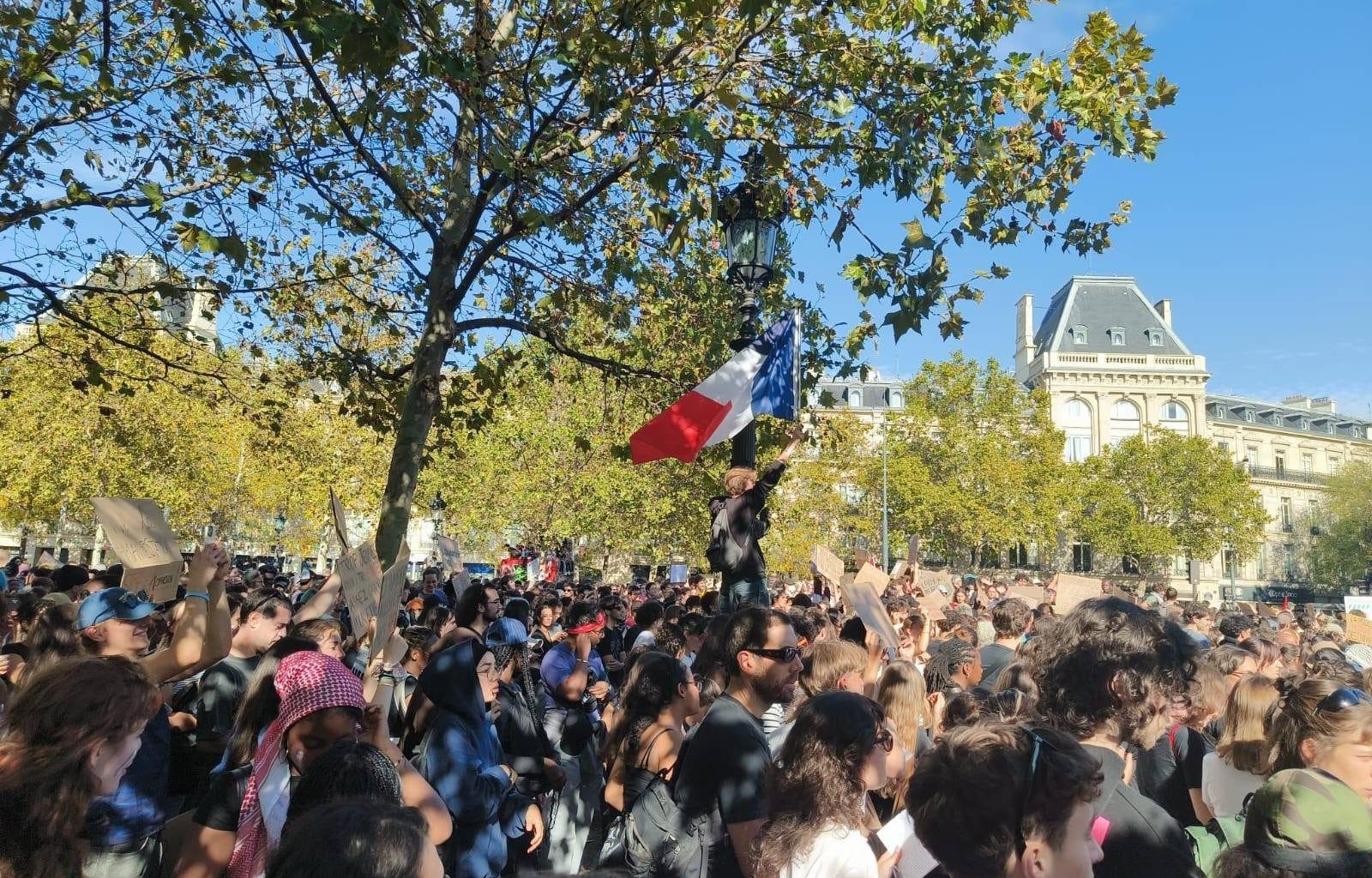
The editors of Red Threads would like to thank the Collective for Social Interventions (KOI), which published the original Bulgarian version of Rositsa Kratunkova’s article on October 19, and say a couple of words by way of introducing its expanded English translation. The article has a two-fold aim: to familiarize the largely aloof Bulgarian–and now, by extension, postsocialist–audience with the causes and grievances of the French protests, and to counter the most pernicious takes in mainstream media that frame the riots as the result of nefarious influence by either migrants or Russia. Such racist projections are not a unique Bulgarian phenomenon but inform the conservative and liberal press throughout Europe. A somewhat amusing take articulated by some liberal commentators has it that the protests are an expression of a supposed “welfare-state fatigue” with the French “nanny-state”, inscribing them into the very neoliberal-macronist reformism the protesters so vehemently reject. Pointing the finger at “outside forces” befits only the most biased observers, but sadly, these abound in the mainstream media. Other pundits cry rivers about the torching of the “beautiful French city”: a recurrent motif in conservative commentary since at least Marx’s times. In the wake of the brutal crushing of the Paris Commune in 1871, Marx chastised the aloofness of the propertied classes from human suffering in the following terms: “The bourgeoisie of the whole world, which looks complacently upon the wholesale massacre after the battle, is convulsed by horror at the desecration of brick and mortar!” His words ring even truer today, not only with regards to the brutality of the French police, but globally so, as the period in the run-up to the protests has been marked by the relentless slaughter of the Palestinian people. Their suffering and aspirations have been recognized by many of the French youth marching on the streets with Palestinian flags and fueling the ire of their conservative and liberal detractors alike who’ve bonded together around a shared Islamophobia.
Many are reacting with shock to the events in France on October 17, when hundreds of thousands of French people took to the streets to demand more dignity and a better life. In many places, the situation spiraled out of control, as illustrated by widely circulated images of burned-out buildings and cars, looted stores, and smashed storefronts. However, to understand what is happening and why, we must move beyond initial emotional, decontextualized claims such as “migrants and communists are to blame for everything” and analyze the broader processes unfolding in the country.
Since mid-September, France has been gripped by student strikes, with students blocking high schools and organizing demonstrations in the streets across the country. They are demanding better material conditions, more teachers, smaller class sizes, and better organization of the educational process. The protest initially began in the French overseas territories of Mayotte and French Guiana, where mothers, students, and teachers criticized the poor conditions. The protest then quickly spread to the mainland, where the situation is similar. One of the largest demonstrations took place on October 6, when—according to data from the Ministry of the Interior—over 56,000 people (or 100,000 according to the organizers) took to the streets of Paris, while nationwide the number ranged between 250,000 and 400,000. Students and teachers were joined by labor unions and political groups such as “Unbowed France” (La France Insoumise), and most recently by “Young Ecologists” (Les Jeunes Écologistes)—the youth wing of the Green Party.
This is not the first time the country has witnessed student protests. In 1990, student strikes lasted more than a month, forcing the government to allocate 4.5 billion francs (1.2 billion euros) for emergency school repairs. Today, students in public schools complain of leaky roofs, classes held in overcrowded classrooms at temperatures of 40 degrees, a lack of basic amenities such as chairs, desks, toilet doors, toilet paper, and soap, as well as a chronic shortage of teachers. In 2019, 60% of students reported feeling exhausted even after a single day at school. In fact, in France, classes begin at 8:00 a.m. and end at 6:00 p.m. (often with a 1- to 2-hour break), making the school day the longest in Europe—25% longer than the average for OECD countries. Overcrowded classrooms are among the most serious problems. The average number of students per class has increased from 27 in 2017 to 30, and in some cases even to 35—the highest figure among OECD countries. Especially since the COVID-19 crisis, mental health among students has been severely affected: 1 in 10 students has attempted suicide, and 29% of young people between the ages of 18 and 24 have had suicidal thoughts, 25% of those aged 15 to 19 exhibit symptoms of depression.
These problems are partly the result of years of underfunding of the public school system—a trend that has accelerated, particularly since the start of Macron’s first term in 2017. More than 10,000 teaching positions have been cut, and another 1,588 are slated for elimination next year. French economist Thomas Piketty notes that between 2017 and 2026, Macron has reduced the budget per student by 20%. Over the past decade, the number of teachers leaving the education system has been steadily increasing: in 2022, approximately 2,800 teachers left, while in 2008 the number was 360. At the start of the 2026 school year, every other school (at the middle and high school levels) was short at least one teacher. This is one of the reasons why the number of teachers working on fixed-term contracts has increased in recent years. These teachers are also in the most precarious position in terms of working conditions. Depending on their level of education, monthly salaries range from 2,063 to 2,575 euros gross. By comparison, in 1980, a middle school teacher started with a salary twice the minimum wage, while in 2026, they will start with only 1.04 times the minimum wage. Even in Bulgaria, the situation is better in this regard.
Officially, the budget cuts are justified by sluggish economic growth and rising costs of borrowing on international markets. Despite ongoing protests, the European Central Bank is pressuring France to adopt next year’s budget to reassure the markets. At the same time, under Macron’s administration, the military budget has doubled. The 2027 budget calls for an increase of 6.4 billion euros, reaching a total of 63.4 billion euros, with nearly half of that amount earmarked for the purchase of weapons and military equipment. Since the beginning of Macron’s term, public spending has not increased, but what has been decreasing is government revenue. This has also led to an increase in the notorious deficit. For example, in the very first year of his presidency, Macron abolished the so-called wealth tax, which has no economic benefit for society other than depriving the treasury of 4 billion euros in revenue per year from the wealthiest. Since 2017, the wealth of billionaires in France has doubled, a trend that has accelerated over the past year or two, while the poverty rate reached 15.4% in 2023—the highest in 30 years. The number of homeless people (sans domicile fixe) doubled, reaching 350,000 in 2024.
What has characterized Macron’s administration over the years is his blatant contempt for the masses, against whom he has waged a class war from the very beginning. His entire administration has been marked by a series of social conflicts—the Yellow Vests, the public healthcare system, firefighters, unions opposing pension reform, and students. Throughout this time, and despite the millions of people protesting, Macron’s governments have made no concessions. On the contrary, they have intensified their attacks. For example, between 2017 and 2023, 30,000 hospital beds were cut, and the pension reform—which raises the retirement age from 62 to 64—was passed under Article 49.3 of the Constitution, i.e., without a parliamentary majority. In 2024, the government canceled over 2 billion euros in funding for the fight against climate change, and in 2026, even though France was experiencing the hottest summer in its history, an additional 1.3 billion euros were cut. At the same time, Macron gave a gift to the well-known French oligarch Vincent Bolloré, who controls over 80% of the media, by forgiving a debt of 320 million euros.
However, the prevailing media framing of the protests, both in Bulgaria and in France itself, hides these facts and instead speaks of migrant riots aimed at destroying France and the “beautiful white French” city. As evidence, we are presented with the rhetorical question: well, if they want better schools, why are they vandalizing them and making them worse? Why are they beating up teachers? Why are they setting trash cans on fire? The focus on these incidents obscures the true source of the violence: the French police.
The state’s primary response to the demands of high school and college students has been massive police repression. Since the start of the protests, 8,000 people—86% of whom are minors—have been detained. There have been cases of extreme brutality: several students have lost their eyes as a result of police rubber bullets, another lost his arm due to a grenade, and a 14-year-old boy was left with almost no teeth and a broken jaw after a grenade explosion. This has even prompted the UN to express concern over the disproportionate police violence. There have been reports of police officers infiltrating the protests to provoke unrest—a fact acknowledged even by the prosecutor’s office, but without any consequences. Recently, the Minister of Education announced that within a few days, 3,000 teachers would be hired to fill the staffing shortage—which raises the question of why they were not hired earlier. However, this remains a temporary measure.
The mobilization of students is taking place just eight months before the presidential election in May 2027, in which far-right leader Marine Le Pen is expected to win the first round. Students, however, are taking an oppositional stance—they are speaking out against the far right, overwhelmingly supporting Palestine, and opposing police violence. More than half are determined to vote in the upcoming elections and sharply criticize a political system that is too disconnected from the lives of young people. The protests have now spread to universities, including some of the most staunchly right-wing and conservative institutions, such as HEC Paris.
All Together for a Decent Life on October 17
On the International Day for the Eradication of Poverty, October 17, hundreds of thousands of French people took to the streets in cities across the country to demand better living conditions, joining the students’ legitimate demands. This is what is known as the “convergence of struggles” (convergence des luttes), when the demands of different segments of society unite against a common “enemy”—the government. In fact, the call to protest was issued even before the student protests began by a “Yellow Vests” supporter to oppose rising fuel prices. It was then taken up by students, labor unions, the “original” Yellow Vests, and political parties such as La France Insoumise.
Over 800,000 people, according to the organizers, and about 550,000 according to the Ministry of the Interior, protested—or rather, were scattered throughout the streets of French cities. Both the organization and the actual course of the protest have been extensively documented on social media, which remains a more accessible platform for presenting a perspective different from that of the media oligarchs controlled by Macron’s inner circle. These posts offer a different view of the causes of the violence. In many places, it is simply impossible to hold a normal march, with clashes between protesters and police breaking out as early as the morning in Marseille and Paris, for example. In Bordeaux, the police began using tear gas just 7 minutes after the official start of the protest. In Paris, instead of letting people join the large procession, the police literally trapped the protesters at Place de la République and began firing tear gas, causing mass panic. Social media, as well as my personal contacts, confirm that the police are behind the provocations, launching unprovoked barrages of tear gas as if they were at war. Since the beginning of Macron’s presidency, there has been a significant increase in both police weaponry and the size of the police force. Over the years, the average French police officer has literally become a “Robocop,” equipped with all manner of technology to be used against people whose “ammunition” consists of saline solution, masks, and possibly firecrackers. The number of water cannons available to the police has also increased, and the police do not hesitate to use them against minors. Although he had banned the use of stun grenades a week earlier—after a 15-year-old boy lost his arm—Interior Minister Laurent Nunez authorized their use again on October 17. Unsurprisingly, another incident involving a severed arm occurred yesterday. This time, the victim of police violence was a 17-year-old boy from Saint-Étienne. In addition to swearing at the protesters, the police also used a stun gun on people in a completely unnecessary and unprovoked manner. In the afternoon, a 22-year-old man committed suicide by jumping from the Arc de Triomphe, while another died of a heart attack during the protest; his age has not yet been determined. A 17-year-old girl lost an eye after being struck by a rubber bullet in the small town of Mulhouse, showing that the violence is not confined to major cities. In Paris alone, 855 people were detained by the police.
Of course, this time too, there were provocations by undercover police officers. For example, numerous videos on social media show protesters clearing barricades to make way for fire trucks and ambulances, with which they stand in solidarity. Elsewhere, there are displays of solidarity with the elderly and others affected by tear gas, as protesters hand out masks and saline solution, and young people move tables and chairs from cafes to protect them. In another video, a police officer disguised as a black-block protester throws a paving stone at a fire truck, after which he is identified by the protesters and stopped. Music and dancing are a key accompanying element, which the police also try to drown out. Thus, the “Nouveau Monde” orchestra manages to play for only about 20 minutes in Place de la République before tear gas drives them away. In Marseille, the police shut down the central train station for hours, trapping people inside, and all trains were canceled.
In addition to peaceful protests, there was also extensive property damage. In Lyon, the tourist office was set on fire; in Paris, numerous (luxury) stores and small businesses were looted; in Limoges, the City Hall was set ablaze; in Lille and Marseille, protesters broke into city hall buildings; and everywhere, benches, traffic lights, and other urban fixtures were smashed. It is precisely these images that dominate the French—and indeed the foreign—media, shifting the focus away from the actual demands. Even before October 17, the government’s main talking point was to portray the student protests as a “movement for urban destruction,” even though at that time the so-called damage consisted mainly of a few torched trash cans. This suggests that one of the likely explanations for the police’s unrestrained behavior yesterday was precisely to provoke retaliatory violence and create the desired (media) image of the protesters—as idlers and thugs who actually want nothing more than to cause destruction. At least that’s one way to explain why so many police officers were seen stealing from looted stores. Or perhaps law enforcement officers were simply taking advantage of the situation to satisfy genuinely urgent needs for air conditioners and sneakers? Another goal is to pin the blame for the riots on Jean-Luc Mélenchon’s party La France insoumise (LFI). As early as the afternoon, at the height of the events, Prime Minister Sébastien Lecornu directly accused Mélenchon for the chaos, as if he had been in power since 2017 and were responsible for public discontent. Mélenchon himself appealed to his supporters not to participate in the unrest.
Here, too, a fundamental divide is evident in perceptions of the protesters. They are divided, from left to right, into peaceful protesters and the “black bloc” or vandals (casseurs), raising the question of the legitimacy of violence and destruction. Since the beginning of his term, Macron has been actively transforming the state into a typical neoliberal one—one that works in the interests of the wealthy, with a strong repressive apparatus to subdue the increasingly impoverished and discontented masses. Workers, students, and the homeless experience numerous acts of violence on a daily basis, which, however, remain hidden. Their natural outlet is through civil demonstrations, but what has years of marching back and forth along boulevards and avenues achieved? What threat does peaceful protest pose to this government? The strikes over pension reform, in which millions have participated, have not been successful. Students have been protesting for a month, and the government’s only response has been to temporarily assign 3,000 teachers to them. Is vandalism, then, legitimate? As some protesters joke: “What’s more important: a dignified future for the children or to send ‘thoughts and prayers’ to the ‘families’ of the smashed storefronts?” What’s more frightening: blinded and maimed students, or a few burning trash cans and stolen “Hugo Boss” blazers? Why do we mourn a cultural heritage building like the burned-down Limoges City Hall, yet remain unmoved by the overcrowded social centers, the growing lines of students waiting for a 1-euro lunch, the appalling condition of school buildings with leaky roofs and non-functioning restrooms, the crumbling public housing, and entire neglected urban spaces where thousands of people live, or the growing number of homeless people on the streets? Is the daily, unjustified, and disproportionate police violence in the poor suburbs of Paris legitimate, and isn’t the protest a space for temporary justice for the “slave”? The question is not whether we desire violence, but whether we understand the reasons for its eruption and assess its legitimacy or lack thereof. For example, the violence perpetrated by far-right groups, who simply go out to beat up protesters in order to violate their right to civic mobilization, is illegitimate.
The violence we are witnessing also raises the question of how authority can be challenged in a democracy. In a country where private property is sacred (Article 17 of the 1789 Declaration of the Rights of Man), where does the right to a dignified life stand? The 1793 Declaration of the Rights of Man, adopted in the first popular referendum in French history but discarded soon after, enshrines the principles of the Revolution: “”When the government violates the rights of the people, insurrection is for the people and for each portion of the people the most sacred of rights and the most indispensable of duties.” (Article 35). On the evening before the anticipated large-scale protest, Macron and his wife attended a concert by Celine Dion, demonstrating the government’s detachment from the people’s needs and legitimizing resistance against it—even through violence.
In French history, October 17 has been a day of police violence on other occasions as well. On that day in 1961, Algerians with French citizenship took to the streets in a peaceful protest against the imposed curfew, which ended with approximately 200 (the exact number is unknown) men and women thrown alive, with their hands tied, into the Seine River, while thousands were detained for days. It seems that 65 years later, colonial and neoliberal power are becoming increasingly similar in their oppressive methods.
Reactions in Bulgaria
Against this backdrop in Bulgaria, where the population lives in poorer material conditions and faces ever-greater hardships—especially since the adoption of the euro—condemnatory views dominate, uncritically accepting the negative media portrayal of the protesters in France. Such views are shared by both liberals and conservative influencers. They blame Mélenchon for the fire at the Limoges city hall while bemoaning the crumbling “French civilization”. In his shock at the violence, the current vice prime minister Ivo Hristov proposes a somewhat depoliticized analysis qualifying the events as a battle of the establishment against all the discontented people. Others compare the far-right attacks on the Capitol following Trump’s defeat in January 2020 to the ongoing “riots” in France. More moderate liberals speak of the multifaceted nature of the protests, declaring the end of the postwar peace in Western Europe, while others lament the end of “moderate democratic models of governance and the rise of political radicalism.” Still others see (their favorite) the long arm of Moscow behind the public discontent. For outspoken Zionists, the only salvation for Europe from the “Arabs” is Israel. Naturally, the overt everyday racism in Bulgaria leads to accusations that “migrants” are responsible for the destruction, citing media footage of non-white people—read: not exactly French—as evidence. In this seemingly diverse array of explanations, political analysis is largely limited to the skin color of the protesters, without taking into account the structural causes related to the specific demands of the French people. However, an attempt at such a broader explanation has come from left-wing figures such as city councilor Vanya Grigorova and BSP leader Krum Zarkov, who point to funding for the war in Ukraine and the fear of a left-wing alternative to neoliberalism as the driving forces.
Presidential Elections 2027 and aftermath of 17 October
The stakes of the protests go beyond school budgets and working conditions in the public sector. Presidential elections are coming, and Marine Le Pen’s far-right party currently leads the polls with about 34%. Macron’s centrist neoliberal party is in a severe crisis and cannot produce a successor, so Le Pen’s opponent will most likely be the leftist Mélenchon. Le Pen recently published a draft budget for France for 2027 that closely mimics Macron’s austerity measures and even calls for deeper budget cuts. Although she was convicted of fraud involving European public funds during her time as a Member of the European Parliament, Le Pen is now proposing a cut of 11 billion euros in France’s contribution to the EU budget, as well as a halt to aid for Ukraine.
A poll conducted a few days ago shows that 49% of young people aged 18–24 would vote for Mélenchon in the first round, well ahead of the 28% for Le Pen. The protests and the government’s response will therefore be decisive in shaping the future of France—and indeed of all of Europe—after May 2027.
The days after the 17th October have even more unequivocally shown the support of the Macronists for the far-right. A day after the “pogroms” and a month after the start of the student protests, President Emmanuel Macron finally addressed the protesters, only to say absolutely nothing concrete regarding their demands. Instead, he issued a moral rebuke, telling the French people to be ashamed, and—unsurprisingly—blamed the “far left” and those engaging in antisocial behavior for the events. Furthermore, he summoned all political parties to a meeting with the prime minister to officially and unambiguously condemn the violence, while at the same time putting regulatory barriers in place to prevent it from happening again. In the coming days, prefects must take measures to protect cities—even if it means banning certain protests. But what can one realistically expect from a president who, after all these years of dismantling the education system and showing contempt for the people, still dares to say something that rings more than hollow: “I understand high school and middle school students; they have been at the center of my political commitment for the past 10 years.”
On Monday 19th October following the announcement of the prime minister Lecornu there was a curfew put in place in many cities, which however seemed to not apply to far right groups, who marched at the center of Lyon screaming “France is ours”. In contrast, scenes from the center of Paris with empty streets, policemen in heavy gear and a helicopter with a beaming light searching for transgressing citizens remind of a dystopic sci-fi adding a new meaning to the ‘ville lumière’. The far-right leader Marine Le Pen published her own video addressing the French people, with the French flag in the background, giving an eerie feeling as if she has already won the elections. The bashing of LFI for the violence and the disorder went as far as fueling demands for its abolition, despite that 20% of the population have expressed their support for Melenchon at the upcoming elections. Such demands come from none other but the president of the Senate: “We were able to dissolve Génération Identitaire (a far-right fringe group) and La Jeune Garde (a far-left movement). LFI is a political party that contributes to the expression of the nation—I acknowledge that. But it bears a significant share of the responsibility for hate speech.”
Amidst these accusations, more and more videos on social media resurface of policemen dressed as black block who break during Saturday’s mobilization. The mayor of Marseille reprimands the police for what he considers to be a deliberate inaction that has allowed groups to break into the municipality uninhibited. The police itself admits that they were overwhelmed and cannot afford another protest like this one. Despite the terrible handling of the situation on Saturday Macron did not accept the resignation of the minister of interior, sending a clear message that for him the problem comes from outside, namely Melenchon’s party.
The revelations of the independent media Mediapart that police chiefs had received explicit orders from above to put the blame for the looting and the violence on LFI and the left come as little surprise. This shows the political manipulation of the popular discontent and the desire of Macron and the capitalist class behind him to put Le Pen in power rather than allow democracy to function and respond to legitimate popular demands for social justice.
In a world marked by a worsening climate crisis, unchecked artificial intelligence that is destroying job market prospects for the youth, rampant nationalism, and geopolitical instability—a situation more reminiscent of 1933— the choice between the left, which stands on the side of life, and the right, which defends property at all costs, has never been so important or so clear.
The words of the Bulgarian socialist and revolutionary Hristo Botev, spoken in the days following the bloody suppression of the Paris Commune in 1871, ring ever truer:
Cry for Paris, the capital of debauchery, of civilisation, the school of espionage and slavery; cry, philanthropists, for the palaces of the dreaded vampires, of the great tyrants – for the monuments to stupidity, to barbarity…
…
Curse the communists, that ruined your capital and died with words which you consider roguish: freedom or death, bread or bullet!
…
The whole world mourns Paris, the whole world curses the communists, and our poor journalism also kept pace with and wept for the soulless, and cursed the wise. Ludicrous cry!
…
Now let our journalism hold back its tears as they will be held back in Europe - to mourn other capitals, other barbarities and sufferings, when the slave cries out to his master: who are you, who weeps? Are you a man, a woman, or a hermaphrodite - a beast or a fish? ... And there will be day – the first day.1
Rositsa Kratunkova is a Bulgarian left-wing activist, who has lived and worked in France for many years, has extensive experience in social work, and currently pursues a PhD in this field.
Translated from the Bulgarian by Sean Foley for Philological Forum, 2019, 2 (10), pp. 202-203. https://philol-forum.uni-sofia.bg/en/issue-10/
