


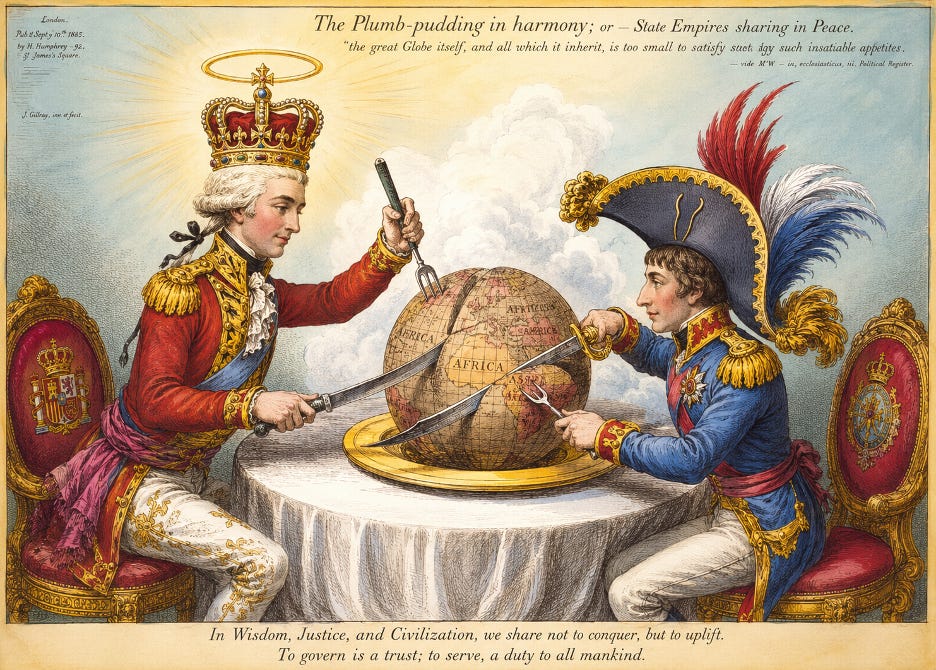
One of the globally most prominent liberal outlets, The New Yorker, published a piece that expresses a sentiment I have not encountered in centrist and liberal channels during the last decade: the West is rational, and the rest of the world is emotional. In the World Cup final, the esteemed magazine tells us, “Spain stood for Europe, the industrial heart of modern soccer, and Argentina was the rest of the world. Colonizer against colonized. Method against madness.”
Due to our deceptive and dishonest “politically correct” culture, it was, until recently, inappropriate to say such things. But an intensifying global backlash during Trump’s second term created an atmosphere where even liberals and progressives felt empowered to make such statements, and the World Cup provided a setting where they could be “legitimately” voiced.
Since I am from that “rest of the world,” I am quite emotional, and the piece was triggering for me. If you are a minority in “Western” countries, or have moved there from the so-called non-West, life is strange – unless you are in denial of what is right in front of you. (No judgment if you are, since denial is frequently a survival mechanism.) There are many “opportunities,” if you are middle-class and above, and occasionally, even if you are working-class. But no matter how much you advance (in terms of either cash, prestige, or power), you feel it: they look at you and always have the suspicion that under that veneer of success lies madness. In liberal towns and venues, they never say it explicitly. Yet you know that when they talk about those “other people, who are not like you,” they fear the emotionality to be running wild in your veins, too. They want to respect you; they wish you could be like them, but it is hard.
Don’t get me wrong. This is not a simple “us vs. them” issue. The suspect people are also wary of each other. Many of them (just like non-liberal “Western people”) are actually more explicit about what they think about “the rest of the world.” In liberal towns especially, you are likely to hear the most racist statements from non-European immigrants rather than from the “civilized” whites who, after all, know how to control themselves methodically. (The New Yorker piece points out: The French and Spanish teams are in control. That’s how civilized people play it.)
I was therefore not surprised when non-Euro-Americans also expressed a lot of hatred against Argentina throughout the World Cup, frequently for reasons that appeared justifiable: some of the players’ foul play, racism, silence about their far-right president, etc. Yet, whenever European teams exhibit these characteristics, people do not trash their nations, let alone the entire continent.
Argentina’s play throughout the tournament was heavy in fouls and dives. However, one can find countless examples in football history of European teams playing dirty. Netherlands in the 2010 WC Final, Italy in 2006, and the Netherlands vs. Portugal game in 2006 are the first ones that come to mind. When European teams play this way, commentators call it “rough,” “street smart,” or “physical play.” When non-Europeans do it, it is madness and brutality.
The more troubling aspect of the discourse around the World Cup was generalizations from football behavior to the broader brutality of Argentinians, and from there to the erratic emotionality of Latin Americans and ultimately of all non-Europeans. Racism should certainly be confronted. Chants, memes, and claims regarding the non-national character of the French football team (because it had Black players) are inexcusable, and were arguably enabled by entrenched Latin American discourses around whiteness. In fact, “non-Western” people have thoroughly internalized Western ways of thinking, as emphasized above, and Argentinians are not immune to that. Silence about the rise of the far right and the commercialization of the game are also problems throughout the world. The heart of commercialization and corporate takeover has been Europe itself for a long time. Messi has come to symbolize this commercialization, but one should not forget that he has been made into a hero and an icon by Barcelona and the European football industry, not just by Argentine or pro-Argentina fans. And although his “Zionism” is exaggerated, there is no question that Messi did not mind being promoted by the Israeli far right, probably due to commercial and pragmatic considerations. Yet, given many current players’ more direct and ideological links to far-right causes and leaders, turning one player from a mass idol into the ultimate villain and embodiment of evil, making a non-European stand for all the sins of the world, cannot but feed racial domination. The treatment of the Iranian team throughout the entire World Cup and the other ways in which US immigration policies negatively affected the teams, referees, and the fans should once again remind us that domination is first and foremost organized at the top, even if it gets frequently internalized, reproduced, and then circulated by those suffering its consequences.
The New Yorker piece exposed that the intense hatred directed against Argentinians was a hatred of the non-West. As tellingly, in the case of non-Euro-Americans, anti-Argentine sentiments were frequently intertwined with self-loathing. Self-hatred is a subtext of most non-Western eulogy of the West. But it is mostly unconscious. Thanks to football, conscious self-flagellation was occasionally on display for several weeks, as in the social media post by a prominent Chilean economist. The post argued that “Argentina’s behavioral crisis” was indicative of Latin American culture. He himself had to “spen[d] much of [his] adult life trying to unlearn” toxic traits he shared with Argentinians. He emphasized that these “traits are among the things that pushed [him] away from the continent.” What the esteemed professor fails to realize is that as long as Euro-American domination persists, no matter how hard he tries, he will still be perceived as a “Latin American” and therefore a carrier of these traits, even if in repressed (and therefore always ready to explode) form. And people will always find evidence that this is the case, as they did of Argentine racism.
Let me make it very clear. The issues I am raising have nothing to do with what team you support. It is how and why you support a team. I have no problem with those who supported Spain, unless they expressed hate against Argentina as a whole. I am not specifically invested in Argentina either. I supported Cabo Verde against them. I was divided when they played Egypt and could not wholeheartedly root for either side. I would support an African team under other circumstances, and on top of that I have special ties to Egypt; but the dictator Sisi is thoroughly identified with the national team. (Yet, the Egyptian football fans known as Ultras were very active in the Egyptian revolution of 2011, and although they have fallen off the political map in recent years, there is a possibility they might be among the leaders of the next democratic awakening, and thereby reclaim their national team from the dictatorship). By contrast, the Argentinian football association (AFA) has been publicly fighting Milei, who wants to smash the neighborhood-club structure of the league’s teams and rebuild football along European lines, which are extremely commercialized and under the thumb of corporations. Moreover, AFA still honors the victims of military dictatorships on its official webpage, which is quite rare in the world of football. Many members of the national team have also sided with Madres de Plaza de Mayo repeatedly. The Spanish national team, on the other hand, is silent on Franco. Yes, some Spanish players have taken progressive stances, and there is no reason why we can’t celebrate that while also acknowledging that racism is quite pervasive in Spanish football. Several incidents, including Spanish fans’ harassment of the team’s Black players, far-right slogans in stadiums, and the Spanish team’s third captain wearing a MAGA hat during the celebrations in Madrid, constitute a dire reminder that football is frequently a venue for the expression of fascistic tendencies in that country too. Just like we must stand with Spanish minorities against these tendencies, we must lend our voice to Argentinians who have been struggling to keep Milei’s hands off Argentinian football.
Now, back to the top. Why do I say the “so-called” non-West and why do I put “the West” in quotation marks? Well, if you think about it, it is really difficult, almost impossible, to separate the West from the non-West neatly. The line is drawn internally, through force and consent. We have been co-constituting each other for millennia, then we forget that we have co-created all these apparent differences between us. I could give many examples of this, but based on my own background, I will just point out the place misleadingly called “Turkey”: genetically, linguistically, culturally, it has been mixing tons of so-called Western and non-Western, Turkish and non-Turkish elements for such a long time… But the depth of this mixing is mostly ignored, if not always deliberately repressed. Thinking that “Turkey” could be lumped into a total category of “madness” is itself quite an unhinged thought, as are many of its leaders’ and citizens’ unending attempts to join the Fortress of methodical, non-insane people, who will never quite accept them as such. Even if “Turks” are officially admitted, their place will be below “those Greeks” and “Hungarians,” the perpetual suspects of unreason in Fortress Europe.
There is only one way to avoid the madness. Not to join the Fortress, but to dismantle this oppressive opposition between the West and “the rest,” along with all the institutions and social relations that enable it.
Undoing the exclusionary borders between method and feelings would also liberate the colonizers themselves. Notice the barely hidden aggression towards and derision of the British in the New Yorker piece. According to the author, the English play with their “feelings,” like the Argentinians, and unlike Spain and France, the true bearers of European values. They have descended to the level of the brutes. The author perhaps can’t forgive them due to Brexit. But shouldn’t he relax a bit? Maybe sometimes it is okay to be a little mad.
On that note, the last decade has repeatedly refuted the essay’s assumption that logic and method will ultimately win over madness. Brexit, Trump, Meloni, and many other far-right victories to come should rid us of any illusion that there is an obvious inevitability to Reason’s triumph. This World Cup was just another contingent event. Whatever The New Yorker constructs as “method” might not win in the next one. Politics and football are games of articulations, coalitions, and struggle – where methods and feelings get combined unevenly – not matches between method and madness.
The exclusion of emotions, and emotional non-Western people, will not help if you want a lasting triumph over the dark forces that seek to destroy this earth. One not only can but should be mad in the face of the elitism and oligarchic plunder that has been devastating the peripheries and semi-peripheries of the world, along with former working-class towns of the global capitalist core. It is illogical to let the far right monopolize the anger unleashed by these processes.
Football cannot be the primary terrain where these conflicts are fought out and resolved. A good chunk of the world left’s overinvestment in Spain created an atmosphere where people expected to see a magic wand in the final game. To non-Argentinians, victory appeared to pave the way to Milei’s defeat and Israel’s embarrassment. In a few days, the hangover will end, and we will face reality, where Netanyahu and Milei will continue the plunder and destruction shamelessly, as they have been doing. Similarly, Argentina’s victory would not have meant a ticket to fascism in the next Argentinian elections but rather the reframing and continuation of the battle between Milei and AFA, as well as a possible shifting of the terms of the struggle between libertarianism and left-wing populism in that country. Nevertheless, football has at least brought to light the contradictions discussed above. And it is only after realizing them openly that we can start to wage a more conscious fight.
Cihan Tuğal is Professor of Sociology at UC Berkeley. He studies capitalism, social movements, religion, and the state. On twitter: @CihanTugal
