


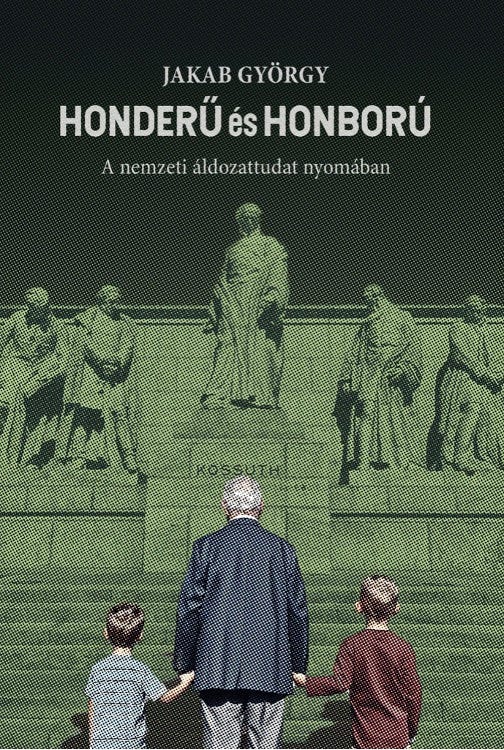
I have in my hands a book full of illuminating moments of perception. György Jakab, a distinguished teacher of history and social studies, an author of curricula and textbooks, and a pioneer in media education, has written something that, in a Hungarian context, recalls the public sociology of Elemér Hankiss: essays on issues of public concern whose influence remains palpable in intellectual life to this day.
Written over the last bout of sixteen years of Orbán’s self-styled “System of National Cooperation,” Honderű és honború is a historical study, a critique of the politics of memory, a program for teaching history—and much more. Its central question is how a particular (Hungarian) collective self-image has emerged: one in which memories of loss, trauma, and grievance often prove more powerful in forming shared group identity than practical judgment, experiences of success, or the work of community building. The question also bears, even when Jakab does not put it in these terms, on a striking feature of the present: the near monopoly of right-wing “habits of the heart,” modes of thinking and speech patterns in Hungary’s public sphere.
Jakab guides the reader through a series of accurate observations about the social production of historical knowledge. My reconstruction of the book’s arc of arguments goes approximately as follows:
Hungarian understandings of history are caught in recurrent configurations of error. Passed from one generation to another, these patterns produce unrealistic assessments of circumstances, mistaken accounts of who “we” are, and poor political decisions.
Collective self-understanding links seemingly contradictory feelings together: aspirations to great-power status mix with a sense of inferiority; a conviction of national exceptionality blends with recurrent feelings of uncertainty and threat.
Central to this self-understanding is the phantom of “Greater Hungary”: a make-believe entity that never existed in quite the form attributed to it.
The trauma associated with its supposed “loss” in the 1920 Treaty of Trianon—part of the post-World-War-I matrix of accords that carved up the Habsburg Empire, created new states, recreated older ones, and re-arranged the region’s borders—is more than just one episode among countless others in Hungarian political history. It remains a mechanism for organizing identity, and perhaps an increasingly powerful one in party politics. The late philosopher G. M. Tamás had an apt term for all that in the Hungarian cultural context: phantom pain.
Jakab also finds older patterns of estate society persisting in modern Hungarian political culture—and, one might add, in economic and social life. They include, at a minimum, a great variety of forms of paternalism, patron–client relations, a gulf between “elites” and the rest of society, and pervasive informality. Jakab’s impressionistic / accurate descriptions trace those patterns to the early sixteenth century: to the suppression of the peasant uprising led by György Dózsa in 1514; István Werbőczy’s Tripartitum (an influential account of Hungarian customary law centered on the nobility, first published in 1517); and the Hungarian kingdom’s defeat by an Ottoman army at Mohács in 1526. Such, it seems, is the particular modernity of Hungarian society in the early 21st century.
That politics of memory produces, reflects, and magnifies social divisions.
The past comes to appear chiefly, sometimes almost exclusively, as a succession of collective traumas, with far-reaching social and psychological consequences. Simplified images of self and world harden around that sequence. What else, then, could govern feelings about the future but honború (national doom), strife at home, and the false consciousness of being threatened on every side?
From these shifts and slippages emerges the “national frame” that dominates Hungarian images of self and world. A product of the nineteenth century projected backward onto earlier periods, this frame is exceedingly difficult to defend as an objective account of history. Its chief purpose becomes the continual cultivation of a sense of victimhood.
Schools, and history teaching in particular, play a crucial part in reproducing these patterns. They could also help society move beyond them, had anybody cared to change the content transmitted.
In this respect, Jakab’s book becomes relevant beyond Hungarian disputes over the politics of memory. It speaks to questions central to international historical scholarship: How “the nation” became the presumed subject of history, and how collective victimhood works as a political form. One especially fruitful conversation would be with the South Korean historian Jie-Hyun Lim, whose work on Poland and elsewhere examines competitive victimhood, transnational memory, and victimhood nationalism. Historical grievances, in this account, are more than things people remember. They organize political identities. Viewed this way, there is nothing fundamentally new or creative about the recent/current Hungarian regimes’ uses of the past.
This brings us to a particularly revealing limitation of Jakab’s book. For all its sensitivity to the inward-looking logic of Hungarian historical consciousness, the book itself seldom steps outside the national story. It largely explains Hungarian victimhood through processes internal to Hungarian history. The ongoing restructuring of imperial systems, reshuffling of the capitalist world economy, the longue-durée patterns and dilemmas of semiperipheral social change, and the historical emergence of the nation-state receive relatively little attention. Yet these wider relations are indispensable to understanding the processes Jakab describes.
The book thus inadvertently exposes a deeper structural feature of history teaching in Hungary. “The nation” remains its seemingly natural organizing unit. The rest of the world serves mainly as background, entering the story when it periodically “intervenes” in Hungarian affairs. The conclusion—that practitioners of this form of consciousness might try the reverse—or, at the very least, try the reverse as well—as an addition to the stories they (the ubiquitous “we”) already tell. Or, displaying even more ambition, instead of adding episodic cross-border excursions to a basically self-contained Hungarian history, historical conversation about the past in the field of intellectual production in Hungary might consider beginning with global historical processes and understanding Hungary as one particular case within them.
In this perspective, Hungary would not appear as a self-standing, isolated, linguistically distinctive society. It would emerge, instead, exposed for centuries to intense connections across its borders, oscillating back and forth within a persistently middling position in the capitalist world-economy, a collectivity that has habitually drawn unusually sharp boundaries between itself and its neighbors. The arc from the defeat at Mohács through Trianon to European integration would become intelligible less as a “national fate” than as a succession of ways of inhabiting changing global configurations.
What, more precisely, do I mean by “global” here? I propose that:
All history—including “Hungarian history”—is made through social, economic, demographic, cultural, linguistic, and other connections that cross borders.
The meaning of “nation” is historically unstable: the early modern noble nation and the modern nation are different things, and it is anachronistic to speak of a nation in today’s sense before the late eighteenth or early nineteenth century.
Comparison is essential. We can make a precise claim about a society only when we know how far that claim extends, and that requires examining other societies rather than assuming uniqueness.
Finally, historical scale matters. We cannot understand the history of a place without asking how it relates to larger and smaller historical and geographical units.
Imagine a beautiful amphora. If any national history, say, Hungarian history, were a Greek vase, conventional Hungarian historical thinking, teaching, and consciousness are deeply committed to working the object. . . almost entirely from the inside. They describe the vessel’s inner contours in exquisite detail and devote enormous energy to relating all qualities of the wine, the oil, all the horrible or wonderful things it contains. But in their enthusiasm for contents, they nearly forget the vessel’s exterior, its function, and its place in the world. What do the outside observers see when they look at it? Where has it stood over the centuries? What stands beside it? Who has kept it clean?
Much of Hungarian history teaching does not yet know how to ask these questions.
Paradoxically, this is what makes the project of Honderű és honború so valuable. Jakab identifies the mechanisms of Hungarian historical consciousness with such acuity that his book all but compels a host of further questions. Is it enough to reread national historical narratives critically? Or must we reconsider the basic unit of analysis around which history is taught?
Perhaps the book’s greatest achievement—quite possibly beyond what Jakab himself intended—is that it makes this possibility visible. For Hungary, a twenty-first-century member of both the European Union and NATO, might it be time to replace national history as the default frame with a relational history—or, perhaps more precisely, a history of position? Such a history would understand a society’s past through its global connections and its continually changing place among other societies. If Jakab’s book helps move Hungarian historical self-understanding from a standard criticism of the national frame toward a genuinely global historical perspective, its effects could reach well beyond its immediate subject.
József Böröcz is a world historical sociologist and a writer, emeritus professor of sociology at Rutgers, The State University of New Jersey. Most of his work can be found here. His last book is a third-person auto-fiction / ironical microhistory titled Hát ez ilyen.
