


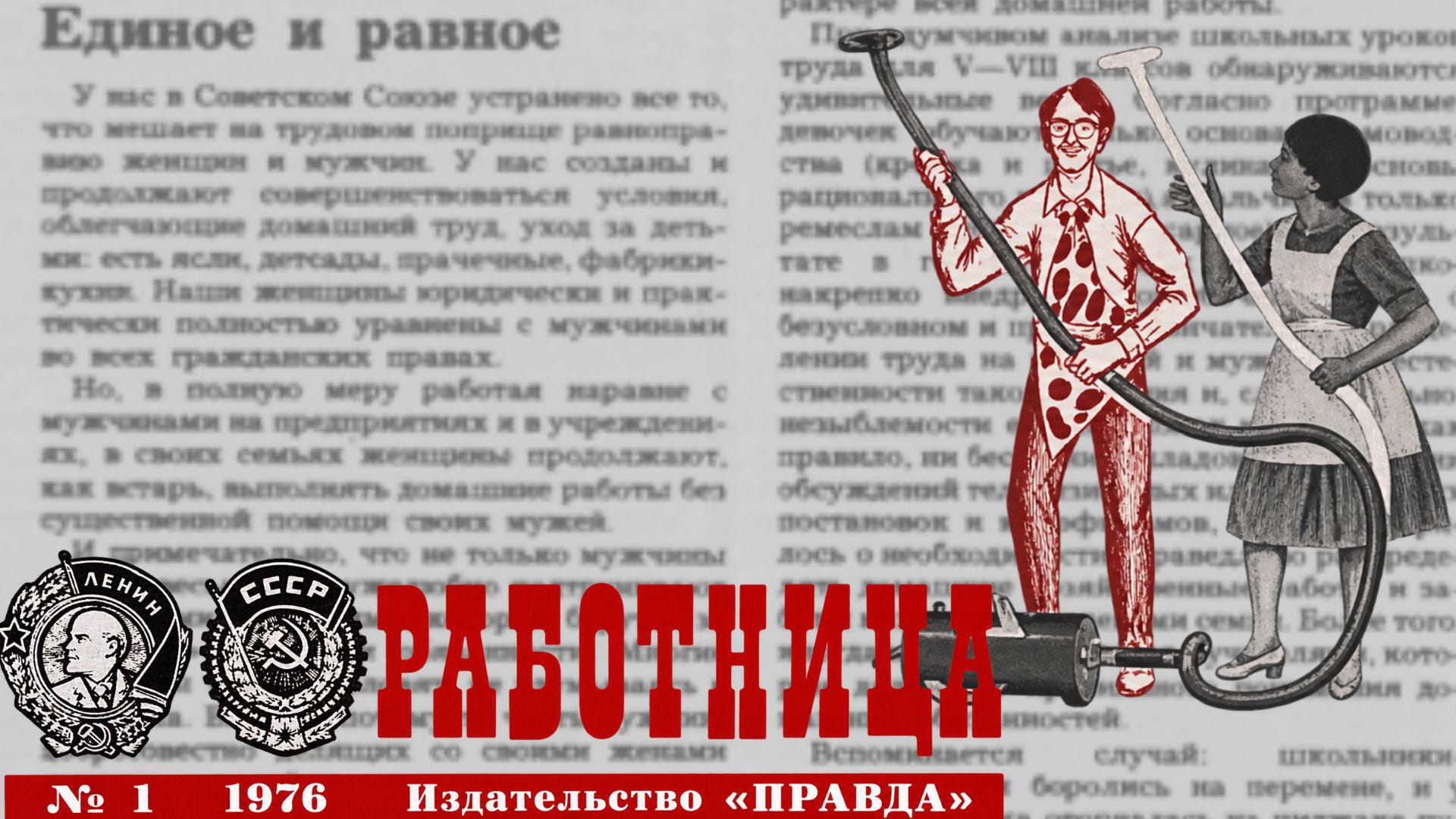
Editorial note: This article is part of Red Feminisms, an ongoing series that aims to recover for theoretical debate, historically grounded contemporary analysis, and militant struggle progressive socialist legacies that sought to restructure the mutually constitutive and historically gendered relationship between productive and reproductive labor, advancing visions for the joint liberation from class, patriarchal, and racial oppression.
The 1970s. The UN Decade for Women was changing the place of women’s rights in international politics. The Convention on the Elimination of All Forms of Discrimination against Women was on its way. “Contact with the feminist movement opens up the possibility of working with the female population of capitalist countries, and most importantly with female youth, who are clearly drawn to the slogans of feminism,”—wrote the Soviet Women’s Committee to the Central Committee of the Communist Party of the Soviet Union, surprisingly, in 1973.[1] This strategic remark illustrated a shift: debates about unpaid work at home and about gender (in)equality were crossing Cold War boundaries. Western feminists looked towards the Soviet project, while Soviet researchers reassessed what socialist policy had—and had not—achieved over the previous decades.
In 1979, British sociologist Maxine Molyneux published the article “Beyond the Domestic Labour Debate,” which ended with the call to rethink the socialist approach to domestic labor and women’s emancipation:
The orthodox socialist position and that of most socialist states today—that of urging women to participate in employment and politics—is, on its own, inadequate precisely because it concentrates only on the external front, and generally ignores the need simultaneously to restructure relations within the home on an equal basis. For such an equalisation to take place there is a need for two types of measure; equalisation of the domestic labour load, which in the case of childless households may be sufficient, plus, in the case of children, a socialisation of this part of the traditional realm of domestic labour.[2]
One year earlier, in 1978, a collective of Soviet sociologists—Elvira Novikova, Vera Yazykova, and Zinaida Yankova—published the volume Woman. Labor. Family through Profizdat, the Soviet trade-union publishing house.[3] Their study of employment, labor law, and everyday life asked what should happen to domestic work, which had persisted after decades of socialist development. The book was not an exception, as historian Mary Buckley wrote about the USSR: “One vigorous debate that began in the mid-1960s and continued throughout the 1970s and into the 1980s was about the position of women in society.”[4] The questions addressed therein included changing women’s roles, and the connection between falling birth rates and women’s paid employment combined with their “double burden.” The debate resulted in a rich and broad scope of research that was “of great interest to Soviet policy-makers because the way in which women organised their lives seriously affected the running of the economy, population size, labour supply, the stability of the family and the nature of childrearing.”[5]
Yet Woman. Labor. Family is especially interesting for two reasons. First, the biography of one of its authors, Elvira Novilova, provides an example of the institutional pathways between Zhenotdel and later Soviet organizations, which remains underexplored. Second, the book addressed the novel question: what if not all domestic labor can be socialized?
From Zhenotdel to Trade Unions
The Bolshevik politics of byt, or everyday life, had already treated cooking, laundry, childcare, and maternity as questions of political economy from the 1920s. As Darya Dyakonova shows in her account of the international communist women’s movement, socialist feminists called for “model social institutions” that would take over women’s economic tasks within the family. Public services would turn activities necessary to reproduce daily life from private female obligations into a general social economy. Lenin’s description of petty housework as labor that “crushes, strangles, stultifies, and degrades” women supplied a canonical argument for this project.
The abolition of the Zhenotdel in 1930, which was followed by a conservative turn in Soviet family policy with the prohibition of abortion and the adoption of a new Family Code in 1936, sharply reduced that horizon. However, not every institutional route through which women could press claims about reproduction was erased. Klavdia Nikolaeva, head of the Zhenotdel in 1924–25, became a secretary of the All-Union Central Council of Trade Unions (AUCCTU) in 1937. After the war, women associated with the Soviet Women’s Committee, including Nina Popova, Tatiana Nikolaeva, Aleksandra Biryukova, and Galina Sukhoruchenkova, repeatedly held senior positions in the trade-union apparatus.[6] Soviet trade unions administered social insurance, monitored labor protection, participated in collective agreements, and oversaw parts of the childcare, healthcare, and service infrastructure. They lacked the bargaining autonomy of unions in capitalist economies, but their welfare responsibilities placed economic production and reproduction of labor under the same institutional roof. The AUCCTU was therefore one corridor through which elements of the earlier agenda entered postwar policy, though under substantially altered political conditions.
Over time, likely because of their engagement in trade unions, the work with women became, once again, formalized. Following a 1962 resolution, the AUCCTU established a commission on women’s labor and everyday life and the protection of mothers and children. It inspected workplaces, monitored legislation, commissioned research, and prepared proposals for economic plans and collective agreements.[7] Its 1969 regulations established as its “most important task” achieving high female labor productivity, while also assigning the commission responsibilities for childcare, training, leisure, and services.[8] Productivity made everyday life a legitimate trade-union concern. Once domestic conditions entered that remit, however, women could make claims that exceeded the goal of increasing labor output.
By 1987, the commission was proposing part-time and home-based employment, as well as transfers to jobs with lower productivity norms for pregnant women and those caring for children or sick relatives.[9] These measures did not pay for housework. They shifted some of the costs of reproduction through time, services, employment protections, and obligations placed on enterprises. The fact that they were mostly addressed at women, however, could also leave their double burden intact.
Novikova entered this institutional and policy setting as a researcher. But while AUCCTU’s institutional history explains the resources and constraints of her work, what she and her colleagues did with the evidence they gathered was to articulate a distinctive argument on the issue of domestic labor.
Elvira Novikova: A Soviet Feminist
Born in 1939 to a family of railway engineers, Novikova lost her father during the Second World War and was raised by her mother and grandmother. Novikova connected their emphasis on education and economic independence to her own formation as “a feminist,” as she explained years later in an interview with Linda Racioppi and Katherine O’Sullivan. After training as a history teacher, she joined the Communist Party in 1963 and worked in the Komsomol before moving into research.[10]
In 1967, Novikova started working at the newly established Institute of the International Labor Movement in Moscow. Her job was to report on women’s status in the United States, based on US newspapers—and that was how she learnt about the feminist movement, as she recalled: “After reading and looking through all these articles, I had the opportunity to order books: Betty Friedan, The Feminine Mystique, Kate Millett, Sexual Politics.”[11] In 1970, Novikova defended her dissertation on the American women’s liberation movement.[12]
In 1973, Novikova took charge of a new AUCCTU research sector concerned with women in trade unions. The records it kept and especially the reports from inspection trips exposed the gap between formal protections and women’s actual working conditions. In 1976, for example, Novikova joined a team investigating the implementation or rather failure of a decree on women’s working conditions in Soviet Ukraine, exposing flaws in the Soviet system.[13] She also became a member of the Soviet Women’s Committee, the official Soviet women’s organization, and later participated in the UN women’s conferences in Copenhagen and Nairobi. Her publications appeared through the AUCCTU’s Profizdat, the state publisher Mysl, and the educational society Znanie.[14]
Her career connected research and policy, Soviet and American debates, and the trade unions with the Soviet Women’s Committee. These connections gave her several ways to examine the contradiction between women’s paid employment and their continued responsibility for domestic life.[15]
What Work Can Socialism Socialize
In Woman. Labor. Family, Novikova, Yazykova, and Yankova argued against Lenin’s sweeping judgment of petty housework. “Such an unambiguous assessment of all household work is unjustified,” they argued. Childrearing and the “mutual education of spouses” could not simply be grouped together with repetitive household maintenance, as it had a political meaning in the USSR. Although they expected that socialist development might overcome the relative economic isolation of domestic labor, they did not expect productive and reproductive life to merge completely, even under communism. That made it necessary to consider what kinds of work would remain within families and how their meaning might change.
The authors distinguished mechanical chores, such as cleaning and laundry, from domestic activities with “educational, organizational, aesthetic, and other essentially creative functions that can be compared with the types of activities [Friedrich] Engels classified as ‘sublime.’” The latter they considered “socially useful, contributing to an increase in the material and spiritual wealth of society” and to “the education and formation of a person.” Calling such work “socially useful” challenged a hierarchy that privileged the production of objects over the formation of people.
Their positive account of some domestic activity did not amount to a defense of existing housework. They strongly advocated for going beyond even the automation of household chores through different devices like vacuum cleaners and washing machines, and instead realize the “industrialization of byt.” However, the authors also emphasized the sociological data that showed unsatisfactory conditions of laundries and canteens in the Soviet Union that prevented women from taking advantage of them. The fact that women often kept doing chores at home was denaturalized but also justified by the inadequate provision of alternatives.
Novikova, Yazykova, and Yankova considered the professional development of women to be the key positive factor in developing progressive attitudes both towards housework, as well as towards childrearing. For example, they showed that women who were more satisfied with their paid jobs were more inclined to save time on domestic labor through technology and services, which they saw as a specifically socialist development. Moreover, unlike widespread attitudes about the mother’s special role in the family due to her natural connection with the child, the authors argued that the more emancipated and more engaged in public life a woman was, the better effect this had on her children:
The nature and extent of a woman’s participation in public life serve as the foundation for the optimal fulfillment of her organizational and educational roles within the family. As A. S. Makarenko rightly noted, “only a mother who herself lives a truly full human and civic life can be a true mother—one who educates, sets an example, and inspires love, admiration, and the desire to emulate her” [29, pp. 441–442]. In this case, the contradictions between “a woman’s professional work and family” and “a woman’s new and old roles within the family” lose their antagonistic nature and are gradually overcome. By relieving women of a certain portion of the burden of child-rearing, society provides them with more opportunities for personal growth and thereby creates better conditions for raising children and adolescents within the family.
The distinction between meaningful care and drudgery carried a risk. If childrearing or homemaking were praised as creative, women could be expected to perform this without relief. However, Novikova and her coauthors opposed this possible conservative reading directly. They called the belief that household chores belonged to women an “old, patriarchal point of view.” Using sociological data, they showed that such attitudes led to women’s dissatisfaction with their family lives, which they also framed as a demographic concern in terms of the crisis of the family and rising divorce rates. Only 15 percent of the women in their research thought such chores were inherently female, and, as the authors stated, these were predominantly elderly women “with a low level of professional and general culture.” Thus, the authors clearly discarded such attitudes as old-fashioned and not Soviet. Where spouses divided domestic work equally, 60.8 percent of women described their marriages as happy and 5.6 percent as unhappy, compared with marriages where women did most of the housework, which 21.6 percent of women described as happy, and 40 percent as unhappy.
If Molyneux would have read Woman. Labor. Family, she would have found a significantly more complex perspective on domestic labor than the one she elaborated just a year before the volume’s publication. Besides advocating for both the equalization and the socialization of domestic labor, Novikova, Yazykova, and Yankova added a critical distinction to this claim. First, socialization could not mean the simple absorption of domestic labor by public institutions. Some activities performed within the family—above all childrearing, education, and forms of interpersonal care that had a political meaning in the USSR—were not merely residues of an inefficient household economy but socially useful and potentially creative forms of labor the value of which socialism had to recognize. The problem was therefore not only how to socialize reproductive labor, but how to distinguish drudgery that should be industrialized or transferred to public services from forms of care needing to be preserved without remaining women’s compulsory responsibility. Second, where Molyneux treated women’s employment primarily as insufficient without a transformation of the household, the Soviet sociologists insisted that it was the indispensable basis of that transformation. Paid work mattered not simply because it took women out of the home or secured their economic independence, but because participation in professional and public life altered women’s position within the family: their expectations of husbands, their willingness to reject a gendered division of household labor, their use of socialized services, and even, they argued, their capacity as parents. The point was to free women from compulsory responsibility for care while at the same time politicizing some types of care, such as children’s upbringing and mutual education of spouses.
Can Women’s Emancipation Be Completed?
Novikova pursued the question of women’s experience more explicitly in later research with fellow sociologists O. L. Milova and E. V. Zaliubovskaia. In an analysis from 1988, they described the exhaustion and anxiety resulting when paid employment, shortages, domestic responsibilities, and expectations of motherhood converged. In their words: “Professional and family life require extreme efforts from women and are accompanied by serious psychological problems, heightened anxiety, etc.”[16] They also explored the feeling of guilt women experienced from the combination of these two roles. Sex stereotypes prevalent in women’s immediate surroundings, they argued, played a crucial role in women’s self-image, and concluded that the less women were expected to fit into traditional gender roles, the more satisfied with everything they were:
The women respondents are self-critical, unsure of themselves, and have a difficult inner life. Many of them are chronically in a state of psychological discomfort, as evidenced by the high level of anxiety, dejection, and bad mood. Anxiety depends directly on satisfaction with marriage, and the husband’s attitude toward the wife’s work. Women who are mainly oriented toward their jobs, however, are less anxious, and better adapted to combining professional activity and motherhood.[17]
A change in the situation of women depended on consistent emancipation, challenging sex stereotypes, and also “inner psychological effort on the part of women.”[18] Overall, they concluded that “what is ‘to blame’ for this [situation] is not women’s emancipation, to which all sins are frequently assigned, but the fact that this process is unfinished, is contradictory, and often takes place in unfavorable forms.”[19] This statement written during perestroika – political-economic liberalization of the Soviet system – explicitly confronted more conservative attitudes regarding women’s roles that began dominating the political mainstream and persist to this day, culminating in the current Russian government’s attacks on women’s right to abortion.
The early communist women’s movement sought to remove reproductive labor from the private household. The conservative turn in the Soviet Union in the 1930s did not erase the questions of socialization of housework and women’s double burden but redirected them to the new institutional spaces: from Zhenotdel to the AUCCTU. Novikova’s generation confronted the work that remained after decades of public childcare, women’s employment, and incomplete socialization. The new question they raised was how to abolish the compulsory feminization of care without imagining women’s liberation as liberation from care itself.
Sasha Talaver is a feminist scholar and activist. She holds a PhD in Gender Studies (CEU) and is currently a postdoctoral fellow at the IRGAC (University of Potsdam).
[1] “Informacii, Pis’ma, Spravki Otdela, Komiteta Sovetskih Zhenshchin, Posol’stv SSSR Po Voprosam Razvitiya Mezhdunarodnogo Zhenskogo Dvizheniya [Information, Letters, References from the Department, the Soviet Women’s Committee and USSR Embassies on the Development of the International Women’s Movement],” December 1973, F.5, Op.66, D.963, RGANI, ll. 69-70.
[2] Maxine Molyneux, “Beyond the Domestic Labour Debate,” New Left Review, no. 116 (July–August 1979), 27.
[3] E. E. Novikova, V. S. Yazykova, and Z. L. Yankova, Zhenshchina. Trud. Semʹia (Sotsiologicheskiĭ Ocherk) [Woman. Labor. Family: A Sociological Essay] (Profizdat, 1978), https://a-z.ru/women/texts/nov1r-4.htm.
[4] Novikova, Yazykova, and Yankova, Zhenshchina. Trud. Semʹia.
Mary Buckley, Soviet Social Scientists Talking: An Official Debate about Women (Houndmills, Basingstoke, Hampshire: Macmillan, 1986), ix.
[5] Buckley, Soviet Social Scientists Talking, ix.
[6] Alexandra Talaver, “Woman Should Be Given the Right to Decide Herself: The Role of the Soviet Women’s Committee (1945-1992),” PhD Dissertation, Central European University, 2025.
[7] E. E. Novikova, T. N. Sidorova, and S. Ia. Turchaninova, Sovetskie Zhenschiny i Profsoiuzy [The Soviet Women and Trade Unions] (Moscow: Profizdat, 1984).
[8] “Polozhenie o Komissii VTSSPS Po Rabote Sredi Zhenshchin” [Regulations on the All-Union Central Council of Trade Unions Commission on Work among Women], October 10, 1969.
[9] GARF, f. P5451, op. 81, d. 68, ll. 2–3.
[10] Linda Racioppi and Katherine O’Sullivan See, Women’s Activism in Contemporary Russia (Philadelphia: Temple University Press, 1997), 34, 38.
[11] Racioppi and O’Sullivan See, 38.
[12] E. E. Novikova, “Polozhenie zhenshchin v SShA i ikh uchastie v borʹbe za mir i sot͡sialʹnyĭ progress (1945–1969 gg.): Avtoreferat dis. na soiskanie uchenoĭ stepeni kandidata istoricheskikh nauk” [The status of women in the USA and their participation in the struggle for peace and social progress (1945–1969): Abstract of thesis for the degree of candidate of historical sciences], Moscow, 1970.
[13] “Otchet Chlenov Komissii Po Rezulʹtatam Proverki Deiatelʹnosti Komissiĭ Po Rabote Sredi Zhenshchin Ukrsovprofa i Zhitomirskogo Oblsovprofa” [Report of the Members of the Commission on the Results of the Inspection of the Activity of the Commissions for Work among Women of Ukrsovprof and Zhytomyr Oblastsovprof], 1976, F. P5451, Op. 81, D. 11, GARF.
[14] Racioppi and O’Sullivan, Women’s Activism in Contemporary Russia, 39, 41.
[15] Novikova’s perspective of combining socialist theory and second wave feminism was rare but not unique in the socialist bloc. See Stana Buzatu, “Issues for a Fruitful Dialogue between Feminism and Marxism,” in Texts and Contexts from the History of Feminism and Women’s Rights: East Central Europe, Second Half of the Twentieth Century, ed. Zsófia Lóránd et al. (Budapest, New York: CEU Press, 2024), 822–32.
[16] Novikova, Milova, and Zaliubovskaia, 104.
[17] Novikova, Milova, and Zaliubovskaia, 99.
[18] Novikova, Milova, and Zaliubovskaia, 100.
[19] Novikova, Milova, and Zaliubovskaia, 101.
